


Stoicism is an ancient Greek and Roman philosophy about living well. It asks you to notice your judgments: the meaning or value you give to events. It also asks you to watch your choices and actions. Stoicism does not promise control over events. It offers a way to act with wisdom, courage, justice, and self-control when life does not go as planned.
I think the word is often made harder than it needs to be. Online, Stoicism can look like a set of stern quotes about pain, discipline, and success. That is only a small part of the picture. The philosophy is not about becoming cold. It is not about pretending that loss does not hurt. It is also not about sitting still while problems grow.
For me, the useful question is simple: when you cannot choose what has happened, what kind of person do you want to be next? This guide explains the Stoic ideas behind that question. I will also show you how to try them without treating them as a cure or a promise of perfect calm.
Stoicism Explained Simply
Stoicism is a way of thinking about a good life. It says that your character matters more than luck, status, comfort, or praise. You cannot make every event go your way. You can still work on how you judge the event, what you choose, and how you treat other people.
Suppose you are preparing for an interview. You can study the role, arrive on time, answer honestly, listen well, and ask good questions. But you cannot force the company to hire you. Other people, budgets, timing, and chance are part of the result. Stoicism does not tell you to stop trying. It asks you to put your effort where it can do real work, then avoid treating the final answer as proof of your worth.
Stoicism is not a trick for feeling nothing. It asks you to think clearly and act well through fear, anger, hope, or disappointment. Practice begins when you notice what is happening in your mind before the first reaction decides your next move.
Where Did Stoicism Come From?
Stoicism can be traced back to Athens around 300 BCE. Zeno of Citium taught near a painted public porch called the Stoa Poikile. The school took its name from that place. It later grew into a broad system of thought. Stoics used logic to test judgments, studied nature to understand our place in the world, and used ethics to decide how to live. They saw people as rational and social, so living well also meant taking our duties to others seriously.
Most beginners now meet Stoicism through three Roman writers. Seneca was a statesman and writer who explored anger, grief, wealth, and time. Epictetus was born enslaved and later became a teacher. He focused on choice, judgment, and responsibility. Marcus Aurelius was a Roman emperor. His personal notes, now known as Meditations, show someone trying to apply Stoic ideas under pressure.
These three men did not invent Stoicism; they lived centuries after Zeno. Much early Greek writing has been lost, so Roman texts are easier to read today. I find them useful, but no quote from Marcus Aurelius represents the whole school. Stoicism had many teachers, debates, and ideas that changed over time.
The Stoic Philosophy Basics That Matter Most
You do not need to master the full system before you begin. The modern habits make more sense when you see the ideas behind them. Four matter most at the start.
Notice Your Judgments Before You React
An event and your view of the event are not always the same thing. If a manager says, “This report needs major changes,” that is the event. Your mind may add, “I am bad at my job” or “They have no respect for me.” Those thoughts may feel like facts, but they are judgments. They can be right, wrong, or only partly true.
Stoicism asks you to slow this step down. First, name what you know. Then name the story you have added. This pause does not erase your feelings, and it does not mean the feedback is fair. It gives you room to ask what the situation needs. You might request examples, correct the work, or speak up about an unclear demand. A more careful judgment can lead to a better action.
Separate Your Choices From Outcomes You Cannot Guarantee
Epictetus starts his Handbook by separating what depends on us from what does not. Many modern guides call this the dichotomy of control. I think this idea needs care. Some things are not fully under your control, but you can still influence them. A job offer, a relationship, an election, or a health result may respond to your actions without being yours to command.
What is more clearly yours is your present choice: whether you prepare, tell the truth, ask for help, set a limit, keep a promise, or try again. These choices matter. Stoicism is not fatalism, which would make effort seem pointless. The line is not between action and doing nothing. It is between your conduct and a result that also depends on other people, events, and chance.
When you remember that line, you can plan seriously without demanding certainty. You can care about the outcome and still know that it is not a final score for your character.
Use the Four Stoic Virtues as a Decision Check
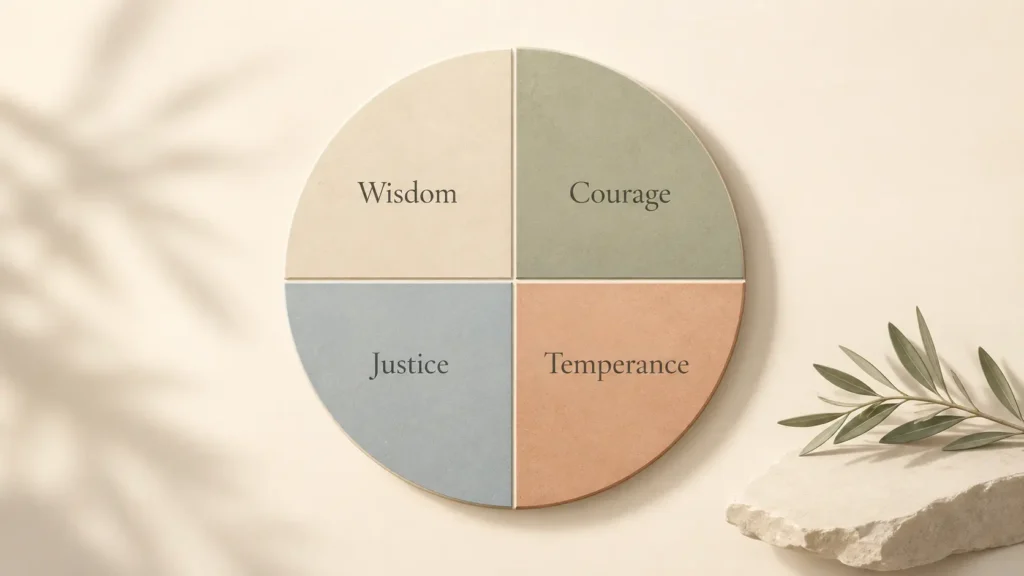
For the Stoics, virtue means good character shown in action. It is the center of the philosophy, not a side note. The four main virtues give you a simple check when you are unsure what to do.
- Wisdom. Try to see the facts, understand what matters, and choose a sound response. If you receive a worrying message, wisdom may mean asking for context before you assume the worst.
- Courage. This means acting on what you believe is right, even when it feels hard. Courage may mean having an honest talk, admitting a mistake, or asking for support. It does not mean seeking pain to prove that you are strong.
- Justice. Treat other people as people, not as tools or obstacles. Justice may mean giving credit, keeping a fair promise, or speaking against harm. This virtue also shows why Stoicism is not only about private calm.
- Temperance. This means using self-control and balance. You pause before an angry reply. You take what you need without letting an urge run the whole day. Temperance is not harsh denial. It is the skill of choosing enough.
These virtues can pull in different directions, so they are not a quick answer machine. Courage without wisdom can become rash. Self-control without justice can become cold. I find it more useful to treat all four as questions, not as badges to award yourself.
Value Health, Relationships, and Success Without Making Them Your Moral Scorecard
The Stoics said that virtue is the true moral good. Health, money, comfort, status, and even long life do not make a person good by themselves. This can sound as if nothing else matters. That is not quite what they meant.
The Stoics knew that health, safety, friendship, and success matter. But they did not see these things as proof of good character. They called them ‘preferred’ or ‘dispreferred externals.’ You can work to protect what is good without treating it as a moral score. Loss can be painful and still leave room for honest, brave, and fair action. Success can be welcome and still say little about how you used it.
What Does Modern Stoicism Mean?
Modern Stoicism is a broad name for how people study and use Stoic ideas today. Some stay close to ancient texts. Others use daily exercises in work, sport, or leadership. Some therapy methods use similar exercises, but Stoicism is a philosophy, not mental-health treatment. Reflection can support daily life, but it does not replace a qualified professional, emergency help, medicine, or trusted support. There is no single modern method.
I think the useful parts of modern Stoicism keep the link between daily practice and character. A morning note about what you can choose is helpful when it leads to wiser or fairer action. A quote is less helpful when it becomes a way to feel above other people, chase status, or ignore a real problem.
Ancient ideas also need thought before we carry them into the present. You can learn from them without assuming every old claim is true or that every modern problem has an ancient answer. For me, modern Stoicism means a careful conversation with the tradition, not a lifestyle label.
Stoicism Is Not the Same as Suppressing Emotion
The Stoics did not think you could simply switch feelings off. They believed some painful reactions become stronger when you accept an untested belief about what happened. Their aim was to examine the belief, not hide the feeling, force a smile, or refuse to name pain.
Anger may arrive before you choose anything. You may notice the heat, the fast thoughts, and the wish to strike back. You do not have to call the anger shameful. Instead, ask what belief is feeding it. Did you decide that another person’s rude words took away your worth? Did you assume you know their reason? The answer may not remove the anger at once. It can stop you from handing the next action to it.
Stoicism also leaves room for care, affection, joy, and concern. Justice makes little sense if other people do not matter. Grief does not prove that practice has failed. It may show that you loved someone or valued something real.
How You Can Practice Stoicism Today
You can turn the philosophy into a small process. You do not need a perfect morning routine or a shelf of old books. You need one real event and a few honest questions.
Suppose you send an important proposal and receive no reply. Your first story may be, “They hate it, and I have failed.” Pause for a moment. The fact is smaller: you sent the proposal, and you do not have an answer yet. You can notice the fear without treating the story as settled truth.
Next, ask what belongs to your choice. The next steps are yours: check that the message arrived, send one clear follow-up, improve the next proposal, and be honest with a colleague about the risk. The client’s answer, agreement, or opinion is not yours to command.
Then use the virtues. Wisdom asks for the facts. Courage asks you to follow up even if you feel exposed. Justice asks you to respect the other person’s time and avoid blame. Temperance asks you not to send five anxious messages.
Finally, act and review. If the result is poor, you can learn from it without turning it into a full judgment of yourself. This process does not guarantee calm. It gives you a better place from which to act.
Is Stoicism Right for You?
Stoicism may suit you if you want a clear way to examine your judgments, take responsibility for your choices, and act by values rather than mood alone. It may be less useful if you turn it into a demand to control every feeling or handle every problem alone.
You do not have to accept every ancient claim to learn from the practice. You can test the ideas with care while leaving room for other views, community support, and professional help. The question is not whether Stoicism solves everything. It is whether it helps you make one wiser, braver, fairer, or more balanced choice.
Further Reading and Sources
- Modern Stoicism: What Is Stoicism? – Beginner starting point. An accessible overview of Stoic judgments, values, and daily life.
- The Enchiridion by Epictetus – Short original text. A public translation of Epictetus’ Handbook; its older wording may feel dated.
- The Meditations by Marcus Aurelius – Original text. A public translation of the personal notes now known as Meditations; its older wording may feel dated.
- Internet Encyclopedia of Philosophy: Stoicism – Deeper reference. A detailed guide to virtue, the good life, and outside conditions.
- Stanford Encyclopedia of Philosophy: Stoicism – Advanced reference. A detailed guide to Stoic history and its linked views of logic, nature, and ethics.
FAQs
What is Stoicism in simple terms?
Stoicism is an ancient philosophy about living well through good judgment and good character. It asks you to focus on your choices and actions while accepting that you cannot command every result. Its goal is not comfort at any cost. Its goal is to act wisely and fairly.
What are the 4 virtues of Stoicism?

The four Stoic virtues are wisdom, courage, justice, and temperance, or self-control. You can use them as a decision check. Ask what is true, what brave action is needed, what is fair to others, and what limit or balance would help you act well.
Is Stoicism about having no emotions?
No. Feelings can arise before you choose them. The Stoics examined the beliefs that can strengthen fear, anger, or grief. Their aim was not to hide every feeling but to respond with better judgment. Stoicism should not be used as a substitute for needed mental-health support.
How can a beginner start practicing Stoicism?
Begin with one daily event. Write the facts, notice the judgment you added, name the choices that are yours, and choose a next action based on one virtue. At night, review the result without blame. A small, steady practice is enough to start learning.
Start With One Thoughtful Practice
You do not need to call yourself a Stoic to learn from Stoicism. Begin with one pause. Separate the event from the story in your head. Then ask what choice is yours and which virtue should guide it.
That may not change the outcome. It may not remove the feeling. It can still help you meet the next moment with more care. For an easy next step, I would read a modern beginner overview first. Then you could try Epictetus’ Handbook or Marcus Aurelius’ Meditations. The encyclopedia entries are better for deeper questions. My rule stays the same: no quote replaces honest thought or good action.
Further Reading and Sources
Here’s what I’ve read to come up with this writing:
- Stanford Encyclopedia of Philosophy: Stoicism – a detailed guide to Stoic history and its linked views of logic, nature, and ethics.
- Modern Stoicism: What Is Stoicism? – an accessible overview of Stoic judgments, values, and daily life.
- The Enchiridion by Epictetus – a public online translation of Epictetus’ short Handbook.
- The Meditations by Marcus Aurelius – a public online translation of the personal notes now known as Meditations.

Leave a Reply