Before I have finished breakfast, I can read about rising prices, a war across the world, and someone my age buying a house I could not afford. I can close the app, but the questions stay with me: Am I doing enough? What happens if my plans fall apart? How much of any of this can I change?
That helps explain why an ancient philosophy has found a modern audience. Stoicism offers a way to live when the future feels uncertain. It asks us to pay attention to our choices, treat other people well, and stop measuring our worth by outcomes we cannot fully control.
The interest is real, although it is hard to put a single number on it. At least 3,650 people signed up for Stoic Week in 2025, a free introduction to Stoic practice. That is one sign of public interest, not a count of everyone who practices Stoicism or proof of why they started. To understand the appeal, I think we need to look at the life into which this philosophy has returned.
Life under pressure, on and off the screen
Money is part of the story. When rent, food, or work feels uncertain, planning for the future can become tiring. In a 2025 survey across 30 countries, 68% of respondents expected inflation to rise in their country over the following year, and 58% expected unemployment to rise. Those worries do not prove that people turn to Stoicism because of the economy. They show the kind of uncertainty in which advice about coping can feel especially useful.
Then there is the pressure to keep improving. We are asked to build careers, stay healthy, be good partners or parents, and make wise decisions about money. Many of these goals are worthwhile. But it is easy to feel that a good life is always one achievement away, or that falling behind means we have failed as people.
Social media sharpens that feeling. A feed can put a friend’s promotion beside a stranger’s perfect home and an alarming headline. I know that I am seeing selected moments, yet comparison can still feel immediate. The same screen brings news of problems far beyond my reach. I can learn about them in seconds without knowing what useful action to take.
But I would miss half the story if I blamed the screen for everything. Social media also helps people find others who are trying to live more thoughtfully. Someone can discover Marcus Aurelius through a short video, ask what a passage means, and hear from people who have tried to apply it. In a study of an online Stoicism community, researchers found that most of the discussions they analyzed involved advice and support about life, rather than academic debate alone. The quality of that advice varies, but the exchange itself matters: philosophy becomes easier to approach when another person is willing to talk it through.
Why look so far back for help?
When life feels noisy, I can see the appeal of advice that begins with a more basic question: What is a good life? Ancient philosophies ask that question before they tell us how to manage our day. They address fear, disappointment, desire, friendship, and duty—experiences that did not begin with smartphones or modern economies.
Their age does not make every ancient claim true. We do not have to accept an entire way of seeing the world to learn from it. What we can do is read it carefully, test an idea in ordinary life, and notice where it helps or falls short. That seems a more useful way to return to the past than treating it as a collection of perfect answers.
Why Stoicism speaks to this moment
Stoicism gives a clear place to start: distinguish your own choices from the results you hope for. I can prepare for a job interview, answer honestly, and decide how I treat the interviewer. I cannot decide whom the company hires. This distinction does not guarantee a calm feeling or a good result. It helps me put my effort somewhere it can count.
The Stoics also challenged the idea that status is the measure of a person. A promotion, praise, or a higher income may be welcome, but none of them tells me whether I have acted wisely, fairly, or courageously. That can be a relief in a culture where comparison is always available. Good character, shown through our actions, is central to Stoic philosophy.
And Stoicism is something people can practice. They can pause before reacting, examine the story they are telling themselves about a setback, or reflect at night on what they did well and what they would change. Stoic ideas helped inspire early forms of cognitive behavioral therapy, a form of talking therapy that helps people examine how their thoughts shape their feelings and actions. That helps explain why parts of Stoicism sound familiar today.
I should be careful with one common misunderstanding. Being Stoic does not mean that I never feel fear, grief, or anger. It means trying to understand those feelings and choose what to do with them. If a colleague is treated unfairly, I may feel angry. I can take that anger seriously without letting it decide every word I say next. Nor does accepting that I cannot control the outcome mean doing nothing: I can speak up and offer help.
Stoicism is one answer among several
The renewed interest in Stoicism sits beside other ways people try to make life more manageable. Mindfulness offers practice in noticing what is happening right now. Minimalism asks which possessions or purchases actually add value. Slow living asks whether every part of life needs to move at the fastest possible pace. Epicurean philosophy, another ancient school of thought, places more weight on simple pleasures, friendship, and freedom from unnecessary distress. Community groups and mutual aid, where people share resources and practical help, ask what we can face together, rather than alone.
These are different approaches, and people often combine them. I might use a Stoic question when a plan fails, put my phone away to give someone my full attention, and rely on neighbors when a problem is too large for one household.
What is worth keeping from the revival?
There is a risk in turning Stoicism into a slogan: be tougher, work harder, accept whatever happens. That may make it easy to sell, but it leaves out much of what drew me to the question in the first place. Some pressures come from unfair workplaces, financial strain, or a lack of support. A calmer reaction can help someone face those conditions; it cannot fix them by itself.
I think Stoicism remains useful when it makes room for both steadiness and action. I can accept that I cannot control every outcome while still caring about justice, asking for help, and changing what I can. Perhaps that is the deeper reason people keep returning to old philosophies. They offer more than a way to get through a difficult day. They ask what kind of life we want to build, and what we owe one another as we build it.
No. Stoicism does not teach you to suppress emotions by pretending they do not exist or pushing them out of sight. But the Stoics also did not believe every emotion should simply be accepted as it is. They wanted to understand the judgments behind destructive emotions and change those judgments.
Imagine that someone says something unfair about you.
You feel your face getting warm. Your heart beats faster. You immediately think of everything you want to say back.
Then you remember something you have heard about Stoicism:
Focus on what you can control. Don’t let emotions control you.
So you say nothing.
You tell yourself you are fine.
But you are not fine. You are still angry. You have simply pushed the anger somewhere nobody else can see it.
That is emotional suppression. It is not what Stoicism asks you to do.
A Stoic would be more interested in questions such as:
What exactly am I feeling?
What happened?
What am I telling myself about what happened?
Is that interpretation accurate?
What is actually under my control?
What would be the right response?
Instead of simply hiding the emotion, you investigate it.
The goal is not to become emotionally numb. It is to understand why certain emotions take control of us and learn to respond with clearer judgment.
That distinction becomes especially useful when dealing with anger, anxiety, sadness, jealousy, and fear.
Do Stoics Suppress Their Emotions?
Emotional suppression and Stoic practice can look similar from the outside.
Suppose your manager criticizes your work in front of several colleagues.
You feel embarrassed and angry.
Suppression might sound like this:
I’m not angry.
It doesn’t bother me.
I shouldn’t feel anything.
Perhaps you remain completely calm in the meeting. But later, you replay the conversation over and over in your head.
A Stoic response begins somewhere else:
I’m angry. Why?
Then you might ask:
Was the criticism actually unfair, or did I simply dislike hearing it?
Am I assuming something about my manager’s intentions?
Does this situation require a response?
If it does, what can I actually do about it?
You are not pretending that the anger is absent. You are trying to understand it before deciding what to do.
There is an important historical nuance here.
It is common today to hear that Stoics wanted to “manage” or “regulate” emotions rather than eliminate them. That is a useful starting point, but the ancient Stoics went further.
They believed certain destructive passions—such as irrational fear, envy, excessive desire, and anger—depend on mistaken judgments about what is truly good or bad.
Their ideal was not simply to feel exactly the same anger while becoming better at hiding it.
It was to change the judgments that created and sustained that anger in the first place.
What Did the Stoics Actually Believe About Emotions?
To understand this, imagine that you send an important message to someone.
Hours pass.
No reply.
Your mind immediately offers an interpretation:
They’re ignoring me.
Then another:
They don’t respect me.
And eventually:
This is terrible.
Soon you are angry, anxious, or both.
From a Stoic perspective, the unanswered message is only part of what happened. Your interpretation of the unanswered message helped shape what followed.
The Stoics called the way something initially appears to us an impression.
For example:
I’ve been insulted.
Something terrible is going to happen.
I need this.
I can’t handle losing that.
You then either accept that first interpretation or question it. The Stoics called accepting an impression assent.
In simple terms, we can think about the process like this:
Something happens → an interpretation appears → we accept or question it → our response develops → we act
This is a simplified way of understanding the Stoic idea, not a modern scientific model of how emotions work.
The important point is that the Stoics did not think we had to believe every interpretation that immediately appeared in our minds.
Destructive Passions and Healthy Feelings
The Stoics made an important distinction between destructive passions and healthy feelings.
They called destructive passions pathē. These are excessive or irrational passions connected with mistaken judgments about what is good or bad.
Traditionally, they grouped them into four broad categories:
Distress: treating something present as an evil.
Fear: expecting some future evil.
Desire: reaching excessively toward something considered a future good.
Pleasure: becoming irrationally elated about something considered a present good.
But this does not mean the Stoics wanted to remove every human feeling.
They also recognized rational or healthy feelings, called eupatheiai, including forms of joy, goodwill, and appropriate caution.
Their ideal was apatheia: freedom from destructive passions.
Despite how the word sounds today, apatheia does not mean apathy.
Apathy suggests that you do not care.
Stoic apatheia means that irrational passions no longer control your judgment.
You can still:
Love people.
Enjoy friendship.
Care about what happens to others.
Recognize danger.
Help someone who is suffering.
Oppose injustice.
Experience appropriate joy.
The goal is not to care less.
It is to care without allowing mistaken judgments and destructive impulses to control what you do.
Feeling Something Is Not the Same as Being Ruled by It
Imagine walking through a parking lot when you suddenly hear a loud crash behind you.
You jump.
Your heart starts racing.
Perhaps your hands shake for a moment.
Would a perfect Stoic simply stand there completely unaffected?
No.
Ancient Stoic writers recognized that human beings experience involuntary first reactions.
Seneca, for example, describes physical reactions that can happen before deliberate judgment has fully entered the picture. A sudden threat can make someone turn pale, tremble, or feel startled.
You cannot reason with your nervous system before a glass falls off the table.
Likewise:
You may immediately feel hurt when someone insults you.
You may become nervous before an interview.
You may feel your stomach drop when you receive bad news.
You may experience a flash of anger when someone treats you unfairly.
The Stoic question is what happens next.
Someone insults you.
The first reaction may simply be:
Ouch.
But then your mind adds:
They humiliated me.
I can’t allow people to treat me this way.
I need to hurt them back.
You may not have chosen the first flash of anger.
But you can examine what you add to it.
That distinction becomes particularly important when dealing with anger.
How Would a Stoic Deal With Anger?
Anger received a great deal of attention from the Stoics, particularly from Seneca, who wrote an entire work called On Anger.
His position was stronger than the familiar advice to “control your temper.”
He did not think anger was a useful force that simply needed to be kept within reasonable limits.
Why?
Because anger can change how we judge a situation.
Imagine that a coworker presents an idea you discussed privately—and takes all the credit.
Your reaction might develop very quickly:
He stole my idea.
He knew exactly what he was doing.
He doesn’t respect me.
I need to make him pay for this.
Notice what happened.
There was an event. Then came assumptions about intention, harm, respect, and what should happen next.
The Stoics treated anger as particularly dangerous because it can turn the judgment that we have been wronged into an impulse toward retaliation.
So a Stoic would not begin with:
How can I stop feeling angry?
A better question is:
What am I currently believing because I am angry?
1. Notice the Reaction
First, acknowledge what is happening.
I’m angry.
Your heart may be racing. Your muscles may be tense. You may already be imagining an argument.
Pretending that none of this exists does not help you understand it.
2. Don’t Act Immediately
Anger creates urgency:
Reply now.
Send the message.
Tell everyone what happened.
Make them understand.
Make them regret it.
Stoic practice creates space between the impulse and the action.
That might mean:
Waiting before replying to an email.
Leaving the room for a few minutes.
Asking for more information.
Deciding not to respond until you understand what actually happened.
The point is not to avoid the problem.
It is to prevent your first impulse from deciding your behavior.
3. Examine the Judgment
Ask yourself:
What actually happened?
What am I assuming about the other person’s intention?
What do I believe I am owed?
What harm has actually occurred?
Does this situation require action?
For example:
Fact: My coworker presented the idea without mentioning me.
Interpretation: He deliberately stole it because he does not respect me.
The interpretation might be correct.
But it might not be.
Stoicism asks you not to confuse the two automatically.
You can also examine the beliefs underneath your anger:
Everyone must recognize my contribution.
Being treated unfairly damages my worth.
If I do not retaliate, I am weak.
Those are judgments worth questioning.
4. Ask What Is Under Your Control
You cannot control:
Whether your coworker behaves selfishly.
Whether everyone recognizes your contribution.
What has already happened.
But you may be able to control:
Whether you ask your coworker about it.
Whether you document your contribution.
Whether you speak to your manager.
How clearly you communicate.
Whether you retaliate.
How you behave afterward.
The problem has not disappeared.
You have simply identified where your effort can actually go.
5. Take the Right Action Without Needing Anger
This is perhaps the most important point.
Stoicism does not mean allowing people to mistreat you.
Suppose your coworker really did steal your work.
You can:
Speak firmly.
Correct the record.
Establish boundaries.
Report misconduct if necessary.
Protect someone else from the same behavior.
Seneca’s argument is that you do not need rage or a desire for revenge to do these things.
You act because the situation calls for action, not because anger demands satisfaction.
Suppression says:
I’m not angry, so I’ll do nothing.
Stoicism asks:
What is the right thing to do here, whether I’m angry or not?
How Would a Stoic Deal With Anxiety?
Anxiety presents a slightly different problem.
Ancient Stoic categories do not map perfectly onto modern psychological terms. The Stoics did not discuss “anxiety” exactly as modern psychology does.
For our purposes, however, we can think of anxiety as worry or fear focused largely on uncertain future outcomes.
What if I fail?
What if they reject me?
What if I lose my job?
What if something goes wrong?
Stoic philosophy pays particular attention to this kind of fear because we often become distressed about outcomes we cannot completely control.
The Stoic response is not simply:
Stop worrying.
Instead, it asks you to examine what the worry is telling you.
1. Separate the Situation From the Prediction
Suppose you have a job interview tomorrow.
The situation is:
I have a job interview tomorrow.
Anxiety may add:
I’m going to perform badly.
Then:
I won’t get the job.
Then:
I’ll never find a good job.
Then:
My career is going nowhere.
Within a few seconds, your mind has traveled from one interview tomorrow to the collapse of your entire career.
Stoic examination brings you back to a simpler question:
What do I actually know?
You know you have an interview.
The rest is prediction.
2. Separate What You Control From the Outcome
You can control, at least to a meaningful degree:
Researching the company.
Preparing relevant examples.
Practicing likely interview questions.
Arriving on time.
Listening carefully.
Answering as well as you can.
You cannot fully control:
Whether another candidate is stronger.
What the interviewer thinks of you.
Whether the budget changes.
Whether the company changes its hiring plans.
Whether you ultimately receive the offer.
Stoicism therefore shifts the goal.
Instead of:
I must get this job.
Try:
I will prepare and conduct myself as well as I can.
You still prefer to get the job.
You simply stop treating an outcome you cannot fully command as though it were entirely yours to produce.
3. Prepare Without Rehearsing Disaster
Stoics sometimes deliberately imagined difficulties that might occur.
This practice is commonly called premeditatio malorum—the premeditation of possible difficulties.
At first glance, that sounds a lot like anxiety.
Isn’t imagining everything that could go wrong exactly what an anxious person already does?
The difference is the purpose.
Rumination says:
What if something goes wrong? What if something goes wrong? What if something goes wrong?
Preparation asks:
What could realistically go wrong, and what would I do if it happened?
For example:
What if I don’t know the answer to a question?
I can admit that honestly and explain how I would find the answer.
What if I am rejected?
I can ask for feedback, continue applying, and improve what I can.
The imagined difficulty now produces a possible response instead of another cycle of worry.
4. Return to the Present Action
Anxiety wants certainty about tomorrow.
But you cannot act tomorrow yet.
You can only act now.
Ask:
What is the next useful thing I can do?
That might be:
Read the job description.
Prepare one example.
Send one email.
Make one phone call.
Practice for 20 minutes.
Get some sleep.
Stoicism repeatedly redirects attention from uncontrollable outcomes toward present choices.
5. Accept That Uncertainty Cannot Be Removed
This may be the hardest part.
Stoicism cannot guarantee that things will go well.
You may prepare carefully and still fail.
You may behave well and still be rejected.
You may make sensible decisions and still experience loss.
What Stoicism offers is not certainty.
It asks whether a bad outcome has to determine how you think, act, or live afterward.
The Stoic answer is no.
You still have choices about how you respond.
Stoic practices can therefore be useful tools for ordinary worry and uncertainty. But Stoicism is a philosophy, not a medical treatment. Persistent, severe, or disabling anxiety may require appropriate professional mental-health support.
What About Sadness, Fear, and Jealousy?
The same basic approach can help us understand several other difficult emotions.
Sadness
Stoicism is sometimes caricatured as telling people not to grieve.
That is too simple.
A Stoic does not need to pretend that losing someone or something important produces no reaction.
Instead, Stoicism asks us to notice the judgments we add to the loss.
There is a difference between:
I miss this person deeply.
and:
My life can never have meaning again.
The first recognizes loss.
The second makes a much larger judgment about your entire future.
Grief can involve natural and involuntary reactions. Stoic practice does not require denying them. It asks us to examine the additional conclusions that can make suffering feel permanent or unbearable.
Fear
Fear often involves a future threat.
You hear a strange noise at night and your body reacts before you have time to think.
That first reaction is not a moral failure.
Then you can ask:
Is there actually danger?
What action is appropriate?
What part of this situation can I influence?
Courage does not necessarily require feeling absolutely fearless.
It means fear does not get the final vote on what you do.
Jealousy
Jealousy often reveals what we believe we need from other people or from comparison.
Someone receives the promotion you wanted.
A friend seems more successful.
Your partner gives attention to someone else.
The feeling may quickly generate judgments such as:
They have something I should have.
Their success makes me less successful.
If I lose this person’s attention, something essential has been taken from me.
Stoicism asks you to examine those beliefs.
Someone else’s success does not determine your character or choices.
And if a relationship genuinely requires a conversation, boundary, or decision, you can take that action without allowing jealousy to decide the entire story for you.
Emotional Suppression vs. Stoic Practice
The difference becomes clearer when we put the two approaches side by side.
Emotional suppression
Stoic practice
“I’m not angry.”
“I’m angry. What am I judging here?”
Deny or hide the feeling
Notice the initial reaction
“I shouldn’t feel this.”
Ask what interpretation is sustaining it
Avoid the underlying problem
Decide whether the situation requires action
Focus on appearing calm
Focus on thinking and acting well
Push the emotion away
Examine the judgment behind it
Avoid conflict at all costs
Take appropriate action when necessary
This explains why looking Stoic and practicing Stoicism are not necessarily the same thing.
A person can sit silently while boiling with resentment.
Another person can speak firmly and openly while thinking clearly.
From the outside, the first person may look more “stoic.”
From a philosophical perspective, the second may be much closer.
A Simple Stoic Process for Difficult Emotions
If you remember only one practical idea from this article, use this five-step process:
Notice — Recognize the physical and emotional reaction.
Name — Identify what you are feeling without pretending it is absent.
Examine — Separate what happened from your interpretation of what happened.
Separate — Identify what is and is not under your control.
Choose — Decide on the most reasonable action available.
This does not guarantee that the feeling will immediately disappear.
That is not the point.
The purpose is to stop treating the first emotion or interpretation that appears as an instruction you must automatically obey.
Stoicism Is Not About Becoming Emotionless
So, do Stoics suppress emotions?
No—not in the sense of feeling anger, fear, sadness, or anxiety and simply forcing those feelings underground.
But Stoicism also does not teach that every emotion is automatically healthy and should simply be accepted exactly as it is.
The Stoics believed many destructive passions depend on mistaken judgments about what is good, bad, necessary, or unbearable.
Their goal was transformation, not concealment.
They wanted to become less angry by changing the beliefs that produce and sustain anger.
Less anxious by changing their relationship with uncertain outcomes.
Less jealous by reconsidering what makes a life valuable.
Less controlled by fear by examining what truly deserves to be feared.
And this did not mean becoming cold.
Stoic philosophy places enormous importance on character, justice, friendship, responsibility, and our relationships with other people.
The calm Stoic is not supposed to be someone who feels nothing because nothing matters.
Ideally, it is someone who has learned to care about the right things without being ruled by every impulse that appears.
Frequently Asked Questions
Do Stoics believe emotions are bad?
Not exactly. Ancient Stoics distinguished destructive or irrational passions from rational “good feelings.” They believed passions such as irrational fear, anger, envy, and excessive desire involve mistaken judgments about what is truly good or bad. At the same time, they recognized appropriate forms of joy, caution, goodwill, and involuntary emotional reactions.
Did Marcus Aurelius suppress his emotions?
Marcus Aurelius repeatedly examines his reactions, judgments, desires, frustrations, and relationships in Meditations. His practice is better understood as an attempt to examine and correct his judgments and behavior than simply to hide feelings. It is also worth remembering that Meditations was a private philosophical exercise rather than a complete textbook of Stoic emotional theory.
What do Stoics say about anger?
Stoics considered anger dangerous because it can distort judgment and create an impulse toward retaliation. Seneca argued extensively against relying on anger, even when responding to genuine wrongdoing. A person can defend themselves, establish boundaries, or correct injustice without needing revenge-driven anger to motivate the action.
Can Stoicism help with anxiety?
Stoic practices can provide a useful framework for ordinary anxiety and uncertainty by separating controllable actions from uncontrollable outcomes, examining catastrophic predictions, and returning attention to present action. However, Stoicism is a philosophy rather than a medical treatment, and persistent or severe anxiety may require professional support.
What is the difference between Stoicism and emotional suppression?
Emotional suppression attempts to hide, deny, or push away an emotion that is already present. Stoic practice asks you to notice your reaction, examine the judgments connected with it, separate what is under your control from what is not, and choose an appropriate response. Its long-term goal is to change the judgments that sustain destructive passions rather than merely conceal them.
Final Thought
When a difficult emotion appears, our first instinct is often to ask:
How do I make this feeling go away?
Stoicism offers a different set of questions:
What am I believing about this situation?
Is that judgment accurate?
What is actually under my control?
What would be the right thing to do now?
You may still feel your heart race.
You may still experience the first flash of anger.
You may still become nervous before something important.
Stoic practice begins when you stop treating that first reaction as an instruction you must obey.
Stoicism has become much more visible in recent years. You may have seen quotes from Marcus Aurelius on Instagram, heard someone say “focus only on what you can control,” or watched a video telling you to stop caring about what other people think.
That sounds Stoic. But is it?
Sometimes, yes. Sometimes, only partly.
Many Stoicism misconceptions start with a real Stoic idea that has been simplified until its original meaning gets lost. Stoicism is not about becoming emotionless, giving up on outcomes, or quietly accepting everything that happens. At its core, it asks a different question: How can I judge a situation clearly, act with good character, and deal well with whatever happens next?
For the Stoics, virtue simply means good character: trying to act with wisdom, courage, justice, and self-control. These qualities matter more than whether every plan succeeds.
Understanding that difference clears up many of the myths surrounding Stoicism.
Quick Answer: Stoicism Myths vs. What the Philosophy Teaches
Common misconception
What Stoicism actually teaches
Stoics suppress emotions
Examine the judgments behind emotions rather than simply hiding feelings.
Stoics do not care
Care deeply without making your peace or character depend completely on what happens.
Stoicism is passive
Accept what has already happened while acting where action is still possible.
Stoicism is just about control
Knowing what is up to you is a tool; using that ability well is the real challenge.
Stoics do not care about success or wealth
You can pursue good outcomes without treating them as the measure of a good life.
Stoicism is cold and solitary
Stoic ethics places strong importance on relationships, fairness, and duties to others.
Stoicism is only for tough men
Stoic virtue is about character, not masculinity or emotional hardness.
Stoicism is pessimistic
Preparing for difficulty is meant to reduce fear and increase gratitude, not make life miserable.
Why Is Stoicism So Often Misunderstood?
Part of the problem is that Stoicism works very well in short quotes:
“Focus on what you can control.”
“Do not be disturbed by what others think.”
“Accept what happens.”
Each can be useful advice. But a complete philosophy cannot fit comfortably into one sentence.
Social media often takes one useful Stoic idea and separates it from the rest of the philosophy. The famous distinction between what is and is not up to us is a good example. Epictetus opens the Enchiridion by separating our judgments and choices from things we cannot fully determine, such as reputation, possessions, and many external events. (MIT Classics)
By external things, Stoics generally mean things that are not completely determined by your choices, such as money, reputation, health, other people’s actions, and whether your plans succeed.
Knowing this distinction is useful. But it does not tell you everything about how you should live.
That is where many misconceptions begin: one Stoic idea is taken too literally or treated as if it were the whole philosophy.
Misconception 1 — Stoics Suppress or Eliminate Emotions
This is probably the most common misunderstanding of Stoicism.
Someone insults you.
You feel angry.
A simplified version of Stoicism might say:
“Don’t feel angry. Stay calm.”
But emotions do not work like light switches.
The ancient Stoics had a more complicated view. They recognized that an initial emotional reaction can appear before we have deliberately decided what to think about it. What matters next is the judgment we add to that reaction.
Imagine your manager criticizes your work during a meeting.
Your stomach tightens. You feel embarrassed. Maybe your face becomes warm.
A Stoic would not need to pretend that nothing happened.
Instead, the next questions might be:
Was the criticism true?
Am I assuming that one mistake means I’m incompetent?
Is my reputation really being destroyed, or am I imagining the worst possible outcome?
What would be the most useful response now?
The Stoics were particularly concerned with emotions that grow from distorted judgments and begin to carry us away.
They also recognized that some emotional reactions happen automatically, before we have time to think about them. The point was not to eliminate every feeling, but to examine the beliefs and judgments that can turn a first reaction into lasting anger, fear, or distress. (Stanford Encyclopedia of Philosophy)
So Stoicism does not ask you to become a robot.
It asks you to create some space between:
“I feel something.”
and:
“Therefore, everything this feeling tells me must be true.”
That is very different from suppressing emotion.
Misconception 2 — Stoicism Means Apathy or Not Caring
Another common misunderstanding is that a Stoic should stop caring about people or things they value.
If you are trying not to be controlled by loss, does that mean you should love people less?
If you are trying not to depend on someone’s approval, does that mean their feelings no longer matter?
No.
Stoicism is not asking you to become emotionally distant from family, friends, or other people.
The important difference is between caring and making your entire well-being depend on something you cannot guarantee.
For example, imagine a close friend is going through a difficult time.
A Stoic response would not be:
“Their feelings are outside my control, so this has nothing to do with me.”
You may not be able to remove their pain, but you can still:
Listen.
Offer practical help.
Be patient.
Speak honestly.
Show up when you are needed.
The Stoic idea is not “care less.”
It is closer to:
Care deeply, but recognize that caring does not give you complete control over what happens.
The same applies to love.
You can value another person enormously without believing:
“If this relationship ever changes, my life will have no value.”
Stoicism tries to make care more stable, not less human.
Misconception 3 — Stoicism Teaches Passive Acceptance or Fatalism
“Just accept it.”
This is one of the most misleading summaries of Stoicism.
Yes, Stoics emphasize acceptance. But acceptance of what?
Usually, it means accepting reality once reality is already here.
Suppose it rains during an outdoor event you planned.
You can spend the next three hours thinking:
“This should not be happening.”
But it is happening.
Acceptance means beginning from the fact in front of you.
Then comes the second question:
“What can I do now?”
You might:
Move the event indoors.
Give people umbrellas.
Change the schedule.
Cancel safely if necessary.
Acceptance removes the useless fight with reality. It does not remove useful action.
The same applies to much more serious issues.
You may not control whether a government changes a policy. But you may still be able to:
Research the issue.
Vote.
Speak publicly.
Organize with others.
Support affected people.
Refuse to participate in something you believe is wrong.
So:
“I cannot determine the final result” does not mean “I have no responsibility to act.”
Stoic philosophy puts considerable emphasis on justice and our duties toward other people. Its idea of justice extends beyond family and friends to how we treat other people more broadly. (Stanford Encyclopedia of Philosophy)
Acceptance tells you where reality currently stands.
Virtue tells you how to respond.
Misconception 4 — Stoicism Is Just “Control What You Can”
“Control what you can” is one of the most useful ideas associated with Stoicism.
It is also one of the easiest to oversimplify.
Epictetus clearly distinguishes between things that depend on us and things that do not. (MIT Classics)
But recognizing that difference does not automatically tell you what to do.
Imagine two people discover that they cannot control what others say about them.
Person A thinks:
“I’ll stop trying to manipulate everyone’s opinion of me. I’ll behave honestly and let people judge me as they will.”
Person B thinks:
“Nobody’s opinion is under my control, so I can treat people however I want.”
Both recognized the same control principle.
Only one used it well.
That is why Stoicism cannot be separated from virtue: wisdom, courage, justice, and self-control.
Knowing what depends on you directs your attention.
Virtue tells you what that attention should be used for.
A simple test is:
If a technique makes you calmer but also makes you more dishonest, cruel, or unfair, it has missed something important about Stoicism.
Calmness can be useful.
It is not the final goal.
Misconception 5 — Stoics Do Not Care About Success, Wealth, Health, or Outcomes
You sometimes hear Stoicism explained like this:
“Money doesn’t matter.”
“Success doesn’t matter.”
“Your health doesn’t matter.”
“The outcome doesn’t matter.”
Again, this pushes a Stoic idea too far.
The Stoics did argue that money, status, health, and other external conditions cannot guarantee a good life.
A rich person can be dishonest and miserable.
A famous person can be fearful and cruel.
A healthy person can still behave badly.
But the Stoics did not generally conclude that we should stop pursuing reasonable goals.
Mainstream Stoicism treated things such as health, wealth, and reputation as reasonable to prefer and pursue under normal circumstances. The key point was that they do not determine whether someone has good character. (Stanford Encyclopedia of Philosophy)
Suppose you have an important job interview.
A Stoic response is not:
“I don’t care whether I get the job.”
It would be closer to:
“I want the job, so I will prepare carefully. But I cannot completely determine the interviewer’s decision. What I can determine is how well I prepare, how honestly I present myself, and how I respond afterward.”
That is not lack of ambition.
It is ambition with limits.
A Stoic can reasonably try to:
Build a business.
Earn more money.
Train for a competition.
Improve their health.
Apply for a promotion.
Build a strong reputation.
Reach an important personal goal.
Stoicism does not require you to stop wanting good things.
It asks whether you can pursue them without sacrificing your character when getting them becomes difficult.
Misconception 6 — Stoicism Is Cold and Solitary
Because Stoicism emphasizes inner judgment and personal responsibility, it can sound like a philosophy designed for someone alone in a room.
You may hear advice such as:
“Work on yourself.”
“Ignore other people’s opinions.”
“Do not depend on others.”
So is the ideal Stoic someone emotionally distant from everyone?
Not really.
Stoic ethics treats human beings as naturally social. Its ideas about justice encourage us to widen our concern outward—from ourselves to family, community, and eventually other human beings more broadly. Philosophers often describe this idea as cosmopolitanism, but the basic idea is simple: your responsibilities do not end with yourself. (Stanford Encyclopedia of Philosophy)
That changes how emotional steadiness should work.
Imagine someone close to you behaves badly.
One option is to explode at them.
Another is to say:
“I am a Stoic. I don’t care.”
But there is a third option.
You can:
Set a clear boundary.
Refuse to accept harmful behavior.
Try to understand the person fairly.
Avoid turning anger into contempt.
Decide what kind of relationship is still reasonable.
That is much closer to the Stoic ideal.
Being less controlled by anger should make it easier to treat someone fairly, not easier to stop caring about them.
Stoicism is not asking you to withdraw from human relationships.
It is asking you to participate in them with better judgment.
Misconception 7 — Stoicism Is a Philosophy Only for Men or “Tough Guys”
Spend enough time around modern Stoicism online and you may encounter a version of it that sounds like this:
Be tougher.
Never show weakness.
Stop complaining.
Win.
Get rich.
Control your emotions.
Some writers call this distortion “Broicism”: using Stoic language to promote hypermasculinity, status, winning, emotional shutdown, or toughness as an identity. A University of Melbourne discussion describes how Stoicism can be reduced to suppressing emotions or becoming better at winning, even though the ancient philosophy had a much broader focus on character. (University of Melbourne)
But toughness is not the same thing as virtue.
Imagine someone who never cries, never complains, and always appears calm.
Does that automatically make the person Stoic?
Not really.
More useful questions are:
Are they fair?
Are they honest?
Do they act courageously when other people need help?
Can they admit when they are wrong?
Those questions tell us much more than whether someone looks tough.
There is also historical evidence against the idea that philosophy itself should belong only to men. The Roman Stoic teacher Musonius Rufus argued that women possess reason and the capacity for virtue just as men do and therefore should also study philosophy. (Internet Encyclopedia of Philosophy)
That does not mean ancient Stoicism was a modern equality movement. It developed inside societies with strong gender inequality.
But the central Stoic goal—developing good character through reason and practice—is not a test of masculinity.
You do not become Stoic by looking tough.
Misconception 8 — Stoicism Is Grim, Pessimistic, or About Seeking Hardship
Stoics sometimes imagined losing the things they valued.
Seneca recommended occasionally living with very simple food and clothing.
Marcus Aurelius reminded himself that irritating people would probably appear during his day.
That can make Stoicism sound depressing.
Why think about bad things when life is already difficult enough?
Because the goal was not to make yourself miserable.
It was preparation.
Seneca, for example, recommended short periods of deliberately simple living so that a person could test whether the poverty they feared was really as unbearable as they imagined. The exercise was meant to reduce fear before genuine hardship arrived. (Wikisource: Seneca, Letter 18)
Another Stoic exercise is to briefly imagine losing something you normally take for granted.
For example, imagine that your regular dinner with your family was suddenly no longer possible.
The purpose is not to make yourself sad.
It is to notice:
“I have something valuable in my life right now, and I often treat it as ordinary.”
Used carefully, the exercise can create gratitude rather than anxiety.
Stoicism is therefore not the same as pessimism.
But it is not blind positive thinking either.
It does not promise:
“Everything will work out.”
Instead, it asks:
“If things do not work out, can I still respond well?”
That creates confidence based on your ability to respond well, rather than confidence that nothing bad will happen.
A Simple Test for “Is This Actually Stoic Advice?”
Stoicism online can be difficult to judge because a piece of advice may sound Stoic without fitting the philosophy very well.
When you encounter a quote, video, or life hack described as Stoicism, ask these five questions:
Does this improve my character, or only help me win? Stoic practices can improve focus and resilience. But if the only goal is money, status, winning, or appearing stronger, the technique has been separated from the philosophy.
Does it distinguish my actions from the final outcome? Stoicism directs more attention toward your choices and less toward trying to guarantee results you cannot fully determine.
Does it preserve my responsibilities toward other people? “Not under my control” should never become an excuse for ignoring fairness, kindness, or responsibility.
Does it help me examine emotions rather than deny them? Asking “Why am I angry?” is different from telling yourself, “I shouldn’t feel angry because Stoics don’t have emotions.”
Would this advice still make sense if I failed? If a supposedly Stoic technique only works when you win, it may be a performance strategy rather than Stoic philosophy.
A useful rule follows:
If “Stoic” advice helps you remain calm but encourages dishonesty, cruelty, emotional denial, or obsession with winning, it has probably kept the technique while losing the philosophy.
What Stoicism Actually Asks You to Practice
So what does Stoic practice look like in ordinary life?
It can be surprisingly simple.
Notice your first reaction. Someone says or does something unpleasant. Before immediately responding, notice what you are feeling and thinking.
Examine the judgment behind it. Ask whether thoughts such as “They don’t respect me” or “This will ruin everything” are facts or conclusions you have added.
Identify what is actually yours to choose. You may not control another person’s behavior, but you can choose how honestly, fairly, and calmly you respond.
Choose the best action available. Sometimes courage means speaking. Sometimes self-control means waiting. Sometimes justice means helping. Sometimes wisdom means admitting that you do not know enough yet.
Pursue the outcome you reasonably want. Try, prepare, negotiate, improve, and protect what matters. Stoicism does not require pretending that outcomes are meaningless.
Accept the final result and learn from it. Once you have done what you reasonably can, recognize that the final result is never completely yours. Learn from what happened and return your attention to the next choice.
That is much closer to Stoic practice than simply trying to “feel nothing.”
Frequently Asked Questions About Stoicism Misconceptions
Does Stoicism mean suppressing emotions?
No. Stoicism does not simply tell you to hide or bottle up feelings. The Stoics recognized that immediate reactions can happen before deliberate thought. Their focus was on examining the judgments that turn those reactions into longer-lasting anger, fear, or distress. (Stanford Encyclopedia of Philosophy)
Is Stoicism the same as being emotionless?
No. Stoicism does not aim to remove every positive feeling. The Stoics distinguished destructive emotions from healthier emotional states such as joy and goodwill. Emotional discipline means examining your reactions, not becoming emotionally numb. (Stanford Encyclopedia of Philosophy)
Does Stoicism teach you not to care about anything?
No. Stoics can care deeply about relationships, health, work, and other things they value. The goal is to care without making your entire character or peace of mind depend on outcomes you cannot completely control.
Is Stoicism passive or fatalistic?
No. Stoicism encourages acceptance of facts and outcomes that cannot now be changed, while still taking responsibility for choices that remain available. Acceptance is meant to help you respond to reality more effectively, not give you an excuse to do nothing.
Is Stoicism only for men?
No. Stoic virtue is based on character and reason rather than gender. The Stoic teacher Musonius Rufus explicitly argued that women, like men, possess the capacity for reason and virtue and should therefore study philosophy. (Internet Encyclopedia of Philosophy)
Final Thoughts: Stoicism Is Not About Caring Less
Most Stoicism misconceptions share the same mistake.
They take something useful from Stoicism and push it too far:
The distinction between what you can and cannot control becomes indifference toward everyone else.
But Stoicism is not mainly about becoming harder.
It is about judging more clearly and acting more virtuously.
That may sometimes make you calmer. It may make you more resilient. It may even make you more effective.
But those are results, not the whole purpose.
If you want to understand Stoicism beyond the quotes, a good next step is to read a primary source such as Epictetus, Seneca, or Marcus Aurelius alongside a reliable modern introduction. That way, individual sayings can be understood as parts of a larger philosophy rather than isolated rules for becoming tougher.
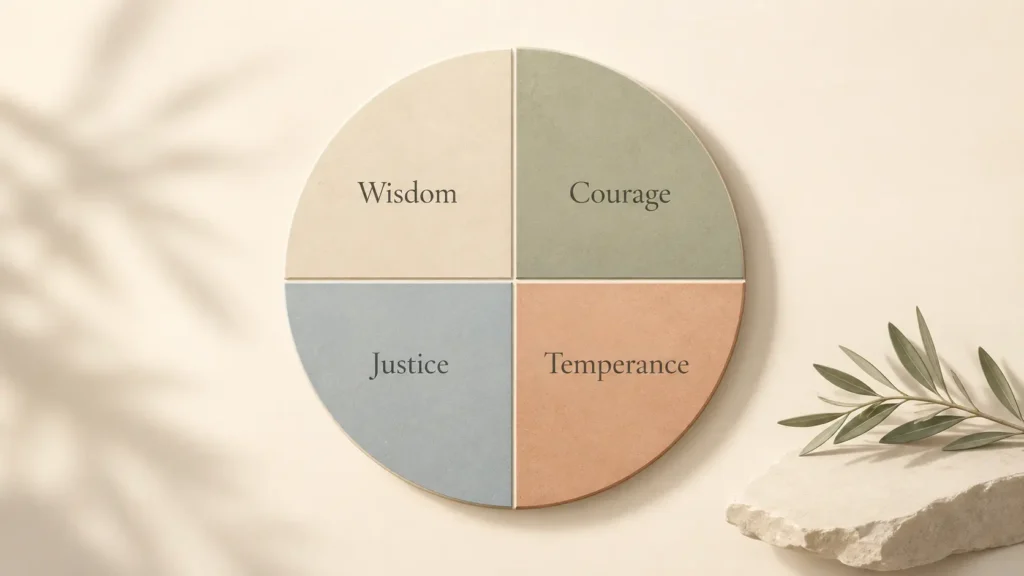
The 4 Stoic virtues are wisdom, courage, justice, and temperance. But the Stoics did not treat them as four badges to collect. They saw them as four parts of one sound character: wisdom reads the situation, justice considers other people, courage carries out the right choice, and temperance keeps fear, desire, and anger from taking control.
That is why Stoic ethics places virtue at the center of a good life. You do not need to master Greek terms or live like a Roman emperor to use the idea. You need a way to pause, see what a situation asks of you, and respond well. This guide explains what each virtue means, how the four work together, and how to use them in one ordinary decision at a time.
The four Stoic virtues at a glance
Virtue
Greek name
Plain-English meaning
Decision prompt
Wisdom
Phronesis
See what is good, bad, or indifferent, then choose soundly.
What is true, valuable, and within my control?
Courage
Andreia
Do what is right despite fear, pain, or social cost.
What right action am I avoiding because it is hard?
Justice
Dikaiosyne
Act fairly and contribute to the common good.
Who is affected, and what do I owe them?
Temperance
Sophrosyne
Govern desire and act in the right measure.
What is enough, and which impulse needs restraint?
What Are the 4 Stoic Virtues?
Let’s start with the word virtue. In Stoicism, virtue is not a polite habit or a trait you display when life is easy. It is excellence of character expressed through judgment and action. A virtuous person tries to understand what is truly good, then chooses in line with that understanding.
And what does cardinal mean? It simply means main or foundational. The four cardinal virtues organize the qualities needed to live well. Other strengths, such as honesty, patience, endurance, and generosity, can be understood as parts or expressions of these four.
Translations vary slightly: wisdom is sometimes called prudence, courage may be called fortitude, and temperance may be called moderation. The labels matter less than the choices they describe. Each virtue asks a practical question about what you see, what you owe, what you will face, and what you must control in yourself.
Why Virtue Is the Only True Good in Stoicism
Here is the claim that can sound strange at first: the Stoics said virtue is the only true good. So, did they think health, money, friendship, and safety did not matter? Not at all. They called these things “indifferents” because none of them, by itself, makes a person morally good or guarantees a good life. Many are still naturally preferred. Good health is naturally preferable to illness; enough money can protect a family; friendship is worth caring for. The question is how you pursue and use them.
Imagine two people receive promotions. One earns the promotion through honest work and uses the role responsibly. The other lies, takes credit, and harms colleagues. The external result is the same, but the quality of the choices is not. For the Stoics, flourishing depends on the character of those choices, not on the title printed on a business card.
This also explains why a good choice can remain good when the outcome goes wrong. You can prepare wisely, act fairly, and speak courageously, yet still lose an opportunity because events are not fully in your hands. The result deserves attention, but it does not rewrite the moral quality of your decision. The familiar Stoic focus on what is within your control is useful here, but it is a tool inside a larger question: what would a wise, just, brave, and disciplined response look like now?
The Four Stoic Virtues Explained
1. Wisdom: See Clearly and Choose Well
Stoic wisdom is practical judgment. It means knowing the difference between what is good, what is bad, and what is neither, then choosing the right response. It is not the same as having a high IQ, collecting facts, or sounding clever. A smart person can still rationalize a selfish choice. Wisdom asks whether the judgment behind the choice is sound.
Suppose your manager says two parts of your report are unclear. Your first thought may be, “They do not respect my work.”
Wisdom slows the story down. What are the facts? Two sections were questioned. What are you adding? A judgment about your reputation. What is actually yours to choose?
You can ask for examples, check the work, revise what is weak, and respond without attacking or retreating. You cannot command another person’s opinion.
Wisdom does not promise certainty. When facts are incomplete and every option has a cost, it means examining the situation honestly, separating evidence from assumption, and choosing the best available action without pretending to know more than you do. That clear judgment guides the other virtues.
Wisdom check:What do I know, what am I merely assuming, and what choice is actually mine?
2. Courage: Do What Is Right Despite Fear
Stoic courage is the strength to endure difficulty and do what reason says is right. It does not mean that fear disappears. In many cases, fear is exactly what makes courage necessary. The brave person notices the risk and still refuses to let fear make the decision alone.
Picture this: you realize you spoke unfairly to someone you care about. Admitting it is embarrassing, and silence feels easier. Courage is not a dramatic speech; it is the plain apology: “What I said was unfair. I am sorry, and I want to make it right.” The action may cost you some pride, but it protects honesty and trust.
That is different from recklessness, aggression, or trying to look tough. Rushing into danger to look bold is not courage. Neither is refusing to change your mind because you want to appear strong. Stoic courage is guided by wisdom and justice. It faces what must be faced for a good reason, in a fitting way.
Courage check:What right action am I avoiding because it is uncomfortable or costly?
3. Justice: Act Fairly and for the Common Good
Stoic justice reaches far beyond courts and punishment. It includes honesty, fairness, respect, kindness, duty, and contribution to shared life. The Stoics saw human beings as social by nature. A good life cannot be built only around private calm while other people carry the cost of our choices.
Consider a team presentation that receives praise. You led the meeting, but a colleague produced the analysis that made the result possible. Justice asks you to share the credit clearly, not because modesty looks attractive, but because the work belongs to both of you. The same test applies when a policy benefits you while placing an unfair burden on someone with less influence. Who gains? Who pays? Whose voice is missing?
Justice does not require pleasing everyone or producing equal outcomes in every case. It asks for honest regard for each person and for the larger community. Sometimes that means setting a boundary, enforcing a fair rule, or refusing a request. The key is the reason: are you protecting a legitimate good, or simply protecting your own advantage? Stoic practice becomes shallow when it offers only personal resilience and forgets responsibility to others.
Justice check:Who is affected by this choice, and what would fairness and goodwill require?
4. Temperance: Govern Desire and Use the Right Measure
Stoic temperance is self-command. It is the ability to govern desires, impulses, and reactions to pleasure, pain, and anger so they do not pull your judgment off course. Temperance does not reject enjoyment. It asks a simpler and more useful question: can you use a good thing without becoming ruled by it?
Imagine you receive an irritating message late at night. Your body is tense, and a sharp reply is already forming. Temperance creates a small gap. You draft the response but do not send it. You step away, sleep, and return when you can say what is needed without adding injury. The same virtue can set a limit on scrolling, spending, drinking, overwork, or any habit that keeps asking for more after you have reached a reasonable limit.
Temperance is not joyless deprivation, passivity, or a rule that the middle option is always best. It is disciplined choice in service of what is good. Sometimes restraint means less; sometimes it means stopping entirely; sometimes it means allowing healthy rest instead of turning work into another excess.
The aim is freedom, not punishment. When appetite, anger, or fear sets the terms, your choices shrink. When you can notice an impulse without obeying it at once, you regain room to act wisely, justly, and courageously.
Temperance check:What is enough here, and which appetite or reaction needs to be governed?
How the Four Virtues Work Together
The four virtues are easy to list separately, but Stoic thinkers treated them as deeply connected: a complete virtue depends on the others. That may sound abstract, so let’s put it into one decision.
Suppose you discover a serious mistake in a report. The mistake currently benefits you because it makes your work look more successful than it was. What happens next?
Wisdom establishes the facts. You check the data, distinguish the error from your fear about it, and identify the sound response.
Justice widens the view. You consider the client, colleagues, and decision-makers who could be misled or harmed.
Courage carries the choice. You disclose the mistake and correct the record even though your reputation may take a short-term hit.
Temperance governs the reaction. You resist hiding evidence, blaming someone else, or turning one error into panic and self-attack.
Now ask, “Which virtue is most important?” Wisdom is sometimes given a leading role because it identifies the good, and justice receives strong emphasis because humans live with and for others. Yet the example shows why ranking them can mislead. A choice that is knowingly unfair is not fully wise. Sound judgment is incomplete if fear prevents you from acting on it. A brave correction delivered in uncontrolled rage may create fresh harm. The virtues are distinct enough to teach, but they work as one system in action.
How to Practice the Four Stoic Virtues Every Day
You do not need a crisis to practice the Stoic virtues. Use them as a short decision check before a difficult conversation, a tempting shortcut, or a strong reaction. Pause and ask four questions:
Wisdom: What are the facts, what is within my control, and what is genuinely good here?
Justice: Who is affected, and what do fairness, honesty, and the common good require?
Courage: What right action am I avoiding because I fear discomfort, loss, or criticism?
Temperance: What impulse, desire, or excess must I govern so I can act well?
Use the Check at Three Points in Your Day
In the morning, choose one likely test. You might expect a hard meeting, an urge to avoid focused work, or a chance to give someone fair credit. Name the virtue that may need special attention, while remembering that the others will support it.
During the day, pause before acting on a strong first impression. The pause can be one breath or a walk around the block. Ask what you know and what story you are adding. Then run the four questions. This is not a trick for removing emotion. It is a way to keep a passing feeling from becoming an unexamined command.
In the evening, review one decision without turning the review into a trial. What did you judge well? Where did fear, self-interest, or excess distort your response? What is one adjustment you can try tomorrow? Marcus Aurelius used private writing to examine his own judgments, but you do not need to copy his format. Three honest sentences are enough.
Expect uneven progress. Stoic practice is training, not a claim of moral perfection. The aim is to notice sooner, correct more readily, and choose with a little more clarity each time. If you handled one part badly, the next virtuous action may be to admit it, repair what you can, and begin again.
Common Misunderstandings About the Stoic Virtues
Stoicism is not emotional suppression. A first wave of fear, sadness, or anger can arise without permission. Virtue concerns the judgment you add and the action you choose. Feeling something is not the same as being ruled by it.
An indifferent is not worthless. Health, relationships, safety, and money can deserve serious care. They are called indifferent only in relation to moral goodness: possessing them does not make you good, and losing them does not make you bad.
Justice is not optional. A version of Stoicism focused only on private calm is incomplete. Your choices take place among other people, so fairness, duty, and the common good belong at the center of practice.
Frequently Asked Questions
What Are the Four Stoic Virtues?
The four Stoic virtues are wisdom, courage, justice, and temperance. Wisdom judges what is truly good and what action fits. Courage does the right thing despite fear. Justice acts fairly and serves shared life. Temperance governs desire and impulse. Stoics treated the four as connected expressions of a sound character.
Where Did the Four Stoic Virtues Come From?
The fourfold scheme predates Stoicism and appears in earlier Greek philosophy, including Plato’s works. The Stoics adopted and developed it within their own account of living well. Diogenes Laertius records wisdom, courage, justice, and temperance among the primary virtues in his surviving summary of Stoic teaching.
Why Did the Stoics Believe Virtue Is the Only Good?
The Stoics believed only excellent judgment and action make a person morally good and support lasting flourishing. Health, wealth, reputation, and comfort may be preferred, but they can be used well or badly. Because external conditions do not determine character, the Stoics called them indifferents rather than true goods.
Which Stoic Virtue Is Most Important?
No Stoic virtue works well in isolation. Wisdom helps identify the right choice, but a choice cannot be fully wise if it is unjust, cowardly, or uncontrolled. The virtues are best understood as one connected system. A real decision usually needs all four, even when one is more visible than the others.
How Can I Practice the Four Stoic Virtues Every Day?
Before an important action, ask what the facts are, who is affected, what right action you are avoiding because of fear, and what impulse needs restraint. Set one intention in the morning, pause before strong reactions, and review one choice at night. Keep the review practical: notice, correct, and try again.
Use All Four in the Next Decision
The four Stoic virtues form a practical sequence: see clearly with wisdom, consider others through justice, face the difficulty with courage, and govern your impulses through temperance. None is a slogan, and none stands alone. Choose one real decision today and run the four-question check before you act. Tonight, review what happened with honesty rather than blame. That small cycle – pause, choose, review, adjust – is where an ancient ethical system becomes a daily practice.
Stoicism History began in Athens around 300 BCE. Zeno of Citium taught in a public porch called the Stoa Poikile, or Painted Porch. That place gave the school its name. The ideas later moved through the Greek world and became especially influential in Rome. If you know Stoicism mainly through Seneca, Epictetus, or Marcus Aurelius, you know an important part of the story, but not the start of it.
The early Stoics also built a wide system about clear thought, nature, and how to live well. In this history of Stoicism, we will follow that system from Greece to Rome, then through its decline, later revivals, and modern practice. Along the way, I will point out what we know, what is uncertain, and what changed.
Here is the main path. The dates are useful guides, not hard borders. Ancient sources are incomplete, so some dates remain approximate.
Around 300 BCE: Zeno begins teaching in the Stoa Poikile in Athens.
Around 262 BCE: Cleanthes becomes the second head of the school and keeps Zeno’s work alive.
Around 230 BCE: Chrysippus takes charge and gives Stoicism much of its detailed shape.
155 BCE: An Athenian group of philosophers visits Rome, drawing public attention to Greek philosophy.
Second and first centuries BCE: Panaetius and Posidonius help Stoic thought reach Roman readers and public life.
First and second centuries CE: Seneca, Musonius Rufus, Epictetus, and Marcus Aurelius produce the Roman-era work we know best.
Late 1500s: Justus Lipsius helps form Neostoicism by joining selected Stoic ethics with Christian belief.
Twentieth century to today: New translations, scholarship, therapy links, books, online groups, Stoic Week, and Stoicon widen the audience.
Where and When Did Stoicism Begin?
The origins of Stoicism are in Athens during the Hellenistic age, the period after Alexander the Great. Athens was still a major place to study philosophy. Several schools taught there at the same time, and they often argued with one another.
Zeno of Citium and the Stoa Poikile
Zeno came from Citium, a city on Cyprus. He reached Athens and studied with several teachers before forming his own school around 300 BCE. He taught at the Stoa Poikile, a public porch painted with scenes from myth and history. People soon called his followers the people of the Stoa, which is where the word Stoic comes from.
You may have heard that Zeno turned to philosophy after a shipwreck. It is a good story, but we should be careful with it. The account comes from Diogenes Laertius, who wrote centuries later. It may preserve an older tradition, yet it is not firm proof of how Zeno’s life changed.
The Ideas That Shaped the First Stoics
Zeno did not begin with an empty page. Socrates helped shape the Stoic belief that character matters more than wealth or status. The Cynic teacher Crates showed him a plain and demanding way of life. Plato’s Academy added questions about knowledge and nature. The Megarian school added careful argument and logic.
So was Stoicism only a mix of older ideas? No. Zeno and his followers joined them in a new way. They argued that a good life needs sound judgment, an understanding of the world, and good action. Those parts were meant to support one another.
Early Stoicism: How the School Built Its System
The Early Stoa usually means the first leaders: Zeno, Cleanthes, and Chrysippus. Almost all their books are lost. We know their ideas through small pieces, later summaries, and critics. That makes the early period harder to describe, but it was the stage when Stoicism became a full school rather than a set of short life tips.
Cleanthes Preserves the School
Cleanthes of Assos followed Zeno as head of the school around 262 BCE. Later stories picture him as poor, hardworking, and deeply loyal to his teacher. His main historical role was simple but important: he kept the young school going. Most of his writing is gone, but his Hymn to Zeus survives. It shows a world ordered by reason and a human duty to live in line with that order.
Chrysippus Systematizes Stoicism
Chrysippus of Soli became the third head around 230 BCE. Ancient reports credit him with many works, though only pieces remain. He gave detailed answers to rival schools and worked across nearly every part of Stoicism. His work in logic was especially important. He studied how statements connect, how arguments work, and when a conclusion follows from what came before it.
Why does he matter so much? Zeno founded the school, but Chrysippus built much of its working frame. A later saying claimed that without Chrysippus there would have been no Stoa. The line is praise, not a measured fact, but it shows his standing in the ancient world.
Logic, Physics, and Ethics Belonged Together
Ancient Stoicism had three linked parts. Logic trained people to test claims and judge what they knew. Physics asked how nature and the whole world worked, including where humans fit within it. Ethics asked how a person should live. You could not simply remove one part without changing the others. The goal was good character, but clear thought and a view of nature were meant to guide it. This is why Stoicism began as much more than a list of moral quotes.
Middle Stoicism: How the Philosophy Moved Toward Rome
After Chrysippus, the center of the story slowly moved beyond the Athenian school. Historians often call the second and first centuries BCE the Middle Stoa or Middle Stoicism. That label is useful, but scholars debate where the period begins, where it ends, and whether these thinkers formed one clear stage.
The Embassy to Rome and a New Audience
A simple turning point came in 155 BCE. Athens sent three philosophers to Rome on a public mission. Diogenes of Babylon represented the Stoics. Carneades represented the Academy, and Critolaus represented Aristotle’s school. Their public talks drew attention. The visit did not make Rome Stoic overnight, but it gave many Romans a close look at Greek debate.
Panaetius and Posidonius Adapt the Tradition
Panaetius later developed close ties with leading Romans. His work on duties influenced Cicero’s On Duties, although Cicero himself was not a Stoic. Panaetius seems to have placed more weight on daily roles and public duty, and he did not accept every early Stoic view.
His student Posidonius taught on Rhodes and wrote on many fields, from ethics to the natural world and history. Both men brought Stoicism into wider talks with Roman life and other schools. Did they replace early Stoicism? No. They kept much of it while changing some points and choosing new areas of focus.
Roman Stoicism: The Thinkers We Can Still Read
Roman Stoicism often feels like the whole tradition because its books are the ones we can still read in full. No complete book by Zeno, Cleanthes, or Chrysippus survives. By contrast, we have major works from Seneca, Epictetus, and Marcus Aurelius. These writers often focus on ethics and daily practice. That focus is real, but it can hide how wide the earlier Stoic system was.
Seneca: Stoicism in Public and Private Life
Seneca lived in the first century CE. He wrote essays and letters about anger, grief, time, wealth, friendship, and death. He also served as an adviser to Emperor Nero and became very wealthy. That gap between his teaching and his life has long raised questions. It also makes him useful to read with care. Seneca did not write from a quiet life outside society. He tried, sometimes unevenly, to apply Stoic ideas inside power, risk, and moral compromise.
Musonius Rufus: Philosophy as Daily Training
Musonius Rufus was a Roman teacher and the teacher of Epictetus. His lessons survive through reports made by others. He treated philosophy as daily training, not as clever talk. He discussed food, clothing, hardship, family life, and education. He also argued that women and men share the same ability to develop good character and should both study philosophy.
Epictetus: Choice, Judgment, and Freedom
Epictetus was born into slavery in the first century CE and was later freed. After philosophers were forced out of Rome under Emperor Domitian, he taught in Nicopolis in Greece. Epictetus wrote no books that we know of. His student Arrian recorded the Discourses and made the shorter Handbook.
His central question was practical: what is truly up to you? Your choices, aims, and judgments are yours to work on. Many results are not. This is often called the dichotomy of control. It does not mean you control every first feeling. It means you can examine the belief you accept and choose your next action.
Marcus Aurelius: A Ruler’s Private Practice
Marcus Aurelius ruled the Roman Empire from 161 to 180 CE. During war, illness, and political pressure, he wrote notes to remind himself how to act. We now call these notes Meditations, but he did not give them that title or prepare them for readers. They are not a full Stoic textbook. They are one person’s private practice, shaped by teachers such as Epictetus. That is why the book can feel direct and moving, but also repeated and unfinished.
Stoicism After the Roman Era
Decline as a Formal School and Later Transmission
There was no single day when Stoicism ended. Its schools, teachers, and public role weakened in late antiquity as the Roman world changed and new schools and religions grew. Many early works were no longer copied, so they disappeared. Still, the ideas did not vanish.
Later Platonist and Christian writers read, used, or argued against Stoic thought. Seneca’s letters and versions of Epictetus continued to circulate. Christian readers often valued Stoic work on discipline and character, while rejecting parts of its view of God and the physical world. What survived was therefore selected and reshaped.
Renaissance Neostoicism
In the late 1500s, the scholar Justus Lipsius led a clearer revival. His 1584 book On Constancy asked how people could use Stoic steadiness during war and public disorder. This movement is now called Neostoicism.
Was it simply ancient Stoicism reborn? Not quite. Lipsius joined selected Stoic ethics with Christian belief. He kept ideas about character and endurance but changed or rejected parts of ancient Stoic physics. Neostoicism shows that a tradition can return by being adapted, not copied whole.
The Modern Revival
The modern revival did not begin with one book or one person. Better editions, translations, and academic study made ancient texts easier to reach during the twentieth century. Scholars also rebuilt early Stoic ideas from later reports and surviving pieces. This helped readers see beyond Marcus Aurelius and recover Stoicism as a broad system.
Modern psychology created another path of interest. In 1955, psychologist Albert Ellis developed rational emotive behavior therapy, or REBT, a form of talk therapy. He openly drew on the Stoic idea that our beliefs about events shape much of our distress. Later therapies that work with patterns of thought use some similar steps, such as checking a belief before accepting it. But the boundary matters: modern therapy has its own evidence, clinical methods, and standards. It is not simply ancient Stoicism with a new name. Stoicism is a philosophy, and it should not replace mental-health care when care is needed.
A public, organized revival became easy to see in 2012. After a workshop at the University of Exeter, Stoicism Today began in October. The first Stoic Week followed in November. Since then, books, podcasts, online groups, courses, Stoicon events, and local meetings have brought Stoic practice to people outside universities.
So what does modern Stoicism mean? There is no single fixed version. Some people focus on journaling and the question of control. Others study ancient texts, social duty, logic, or the Stoic view of nature. Most modern readers do not accept every ancient claim about the physical world. Many select practical exercises and ethics instead.
That choice can help, but it can also narrow the picture. Stoicism is not emotional silence, and a few Marcus Aurelius quotes do not stand for the whole school. Ancient Stoics allowed that a first feeling can arise before you choose it. Their concern was what judgment you accept and what you do next. Their goal also included care for other people and responsible action, not withdrawal from life.
How Did Stoicism Change Over Time?
If I had to sum up the change, I would put it this way: the setting, surviving books, and common focus moved, while the concern with reason, character, and living well stayed near the center.
Period
Main setting
Common focus
Easy mistake to make
Early Greek school
Athens
A linked system of logic, nature, and ethics
Reducing it to short life advice
Roman period
Homes, schools, and public life
Ethics, training, duty, and judgment
Treating Roman texts as the entire school
Modern revival
Books, therapy links, courses, and online groups
Practical exercises and personal conduct
Assuming all modern Stoics agree
The table also explains why modern views can feel incomplete. We usually read what survived, and what survived came mainly from Rome. A fair history keeps the practical Roman voice while remembering the larger Greek system behind it.
Frequently Asked Questions About Stoicism History
Who founded Stoicism?
Zeno of Citium founded Stoicism in Athens around 300 BCE. He learned from the Cynic school, Plato’s Academy, and the Megarian school before forming his own school. Cleanthes kept it going after him, and Chrysippus later built much of its detailed system.
When and where did Stoicism begin?
Stoicism began in Athens around 300 BCE, during the Hellenistic age. Zeno taught at the Stoa Poikile, or Painted Porch, in the city’s public market area. The school took its name from that place.
What are the three periods of Stoicism?
The usual three periods are the Early Stoa, Middle Stoa, and Roman or Late Stoa. These labels help organize the story, but their borders are not exact. Scholars also debate how useful the Middle Stoa label is.
Did Marcus Aurelius create Stoicism?
No. Marcus Aurelius lived about four centuries after Zeno founded the school. He was a Roman emperor who practiced Stoicism and wrote private notes now called Meditations. His book is important, but it is not the start or the whole of Stoicism.
Why did Stoicism become popular again?
Stoicism returned through new translations, modern scholarship, links with cognitive therapies, and popular books and online groups. Public projects such as Stoic Week, which began in 2012, also made its exercises easy for beginners to try. The revival has no single leader or fixed form.
From the Painted Porch to the Present
The history of Stoicism follows three broad steps. Zeno founded a Greek school in Athens. Later thinkers built its system and carried it into Roman life, where the fullest surviving books were written. After the formal school faded, readers kept selecting, debating, and reshaping its ideas until modern Stoicism appeared. If you want to continue, begin with a short overview, then read Epictetus or Marcus Aurelius with this history in mind. Their words become clearer when you can see the long tradition behind them.
Sources and Further Reading
These sources provide fuller historical detail and access to surviving texts.
Stoicism is an ancient Greek and Roman philosophy about living well. It asks you to notice your judgments: the meaning or value you give to events. It also asks you to watch your choices and actions. Stoicism does not promise control over events. It offers a way to act with wisdom, courage, justice, and self-control when life does not go as planned.
I think the word is often made harder than it needs to be. Online, Stoicism can look like a set of stern quotes about pain, discipline, and success. That is only a small part of the picture. The philosophy is not about becoming cold. It is not about pretending that loss does not hurt. It is also not about sitting still while problems grow.
For me, the useful question is simple: when you cannot choose what has happened, what kind of person do you want to be next? This guide explains the Stoic ideas behind that question. I will also show you how to try them without treating them as a cure or a promise of perfect calm.
Stoicism Explained Simply
Stoicism is a way of thinking about a good life. It says that your character matters more than luck, status, comfort, or praise. You cannot make every event go your way. You can still work on how you judge the event, what you choose, and how you treat other people.
Suppose you are preparing for an interview. You can study the role, arrive on time, answer honestly, listen well, and ask good questions. But you cannot force the company to hire you. Other people, budgets, timing, and chance are part of the result. Stoicism does not tell you to stop trying. It asks you to put your effort where it can do real work, then avoid treating the final answer as proof of your worth.
Stoicism is not a trick for feeling nothing. It asks you to think clearly and act well through fear, anger, hope, or disappointment. Practice begins when you notice what is happening in your mind before the first reaction decides your next move.
Where Did Stoicism Come From?
Stoicism can be traced back to Athens around 300 BCE. Zeno of Citium taught near a painted public porch called the Stoa Poikile. The school took its name from that place. It later grew into a broad system of thought. Stoics used logic to test judgments, studied nature to understand our place in the world, and used ethics to decide how to live. They saw people as rational and social, so living well also meant taking our duties to others seriously.
Most beginners now meet Stoicism through three Roman writers. Seneca was a statesman and writer who explored anger, grief, wealth, and time. Epictetus was born enslaved and later became a teacher. He focused on choice, judgment, and responsibility. Marcus Aurelius was a Roman emperor. His personal notes, now known as Meditations, show someone trying to apply Stoic ideas under pressure.
These three men did not invent Stoicism; they lived centuries after Zeno. Much early Greek writing has been lost, so Roman texts are easier to read today. I find them useful, but no quote from Marcus Aurelius represents the whole school. Stoicism had many teachers, debates, and ideas that changed over time.
The Stoic Philosophy Basics That Matter Most
You do not need to master the full system before you begin. The modern habits make more sense when you see the ideas behind them. Four matter most at the start.
Notice Your Judgments Before You React
An event and your view of the event are not always the same thing. If a manager says, “This report needs major changes,” that is the event. Your mind may add, “I am bad at my job” or “They have no respect for me.” Those thoughts may feel like facts, but they are judgments. They can be right, wrong, or only partly true.
Stoicism asks you to slow this step down. First, name what you know. Then name the story you have added. This pause does not erase your feelings, and it does not mean the feedback is fair. It gives you room to ask what the situation needs. You might request examples, correct the work, or speak up about an unclear demand. A more careful judgment can lead to a better action.
Separate Your Choices From Outcomes You Cannot Guarantee
Epictetus starts his Handbook by separating what depends on us from what does not. Many modern guides call this the dichotomy of control. I think this idea needs care. Some things are not fully under your control, but you can still influence them. A job offer, a relationship, an election, or a health result may respond to your actions without being yours to command.
What is more clearly yours is your present choice: whether you prepare, tell the truth, ask for help, set a limit, keep a promise, or try again. These choices matter. Stoicism is not fatalism, which would make effort seem pointless. The line is not between action and doing nothing. It is between your conduct and a result that also depends on other people, events, and chance.
When you remember that line, you can plan seriously without demanding certainty. You can care about the outcome and still know that it is not a final score for your character.
Use the Four Stoic Virtues as a Decision Check
For the Stoics, virtue means good character shown in action. It is the center of the philosophy, not a side note. The four main virtues give you a simple check when you are unsure what to do.
Wisdom. Try to see the facts, understand what matters, and choose a sound response. If you receive a worrying message, wisdom may mean asking for context before you assume the worst.
Courage. This means acting on what you believe is right, even when it feels hard. Courage may mean having an honest talk, admitting a mistake, or asking for support. It does not mean seeking pain to prove that you are strong.
Justice. Treat other people as people, not as tools or obstacles. Justice may mean giving credit, keeping a fair promise, or speaking against harm. This virtue also shows why Stoicism is not only about private calm.
Temperance. This means using self-control and balance. You pause before an angry reply. You take what you need without letting an urge run the whole day. Temperance is not harsh denial. It is the skill of choosing enough.
These virtues can pull in different directions, so they are not a quick answer machine. Courage without wisdom can become rash. Self-control without justice can become cold. I find it more useful to treat all four as questions, not as badges to award yourself.
Value Health, Relationships, and Success Without Making Them Your Moral Scorecard
The Stoics said that virtue is the true moral good. Health, money, comfort, status, and even long life do not make a person good by themselves. This can sound as if nothing else matters. That is not quite what they meant.
The Stoics knew that health, safety, friendship, and success matter. But they did not see these things as proof of good character. They called them ‘preferred’ or ‘dispreferred externals.’ You can work to protect what is good without treating it as a moral score. Loss can be painful and still leave room for honest, brave, and fair action. Success can be welcome and still say little about how you used it.
What Does Modern Stoicism Mean?
Modern Stoicism is a broad name for how people study and use Stoic ideas today. Some stay close to ancient texts. Others use daily exercises in work, sport, or leadership. Some therapy methods use similar exercises, but Stoicism is a philosophy, not mental-health treatment. Reflection can support daily life, but it does not replace a qualified professional, emergency help, medicine, or trusted support. There is no single modern method.
I think the useful parts of modern Stoicism keep the link between daily practice and character. A morning note about what you can choose is helpful when it leads to wiser or fairer action. A quote is less helpful when it becomes a way to feel above other people, chase status, or ignore a real problem.
Ancient ideas also need thought before we carry them into the present. You can learn from them without assuming every old claim is true or that every modern problem has an ancient answer. For me, modern Stoicism means a careful conversation with the tradition, not a lifestyle label.
Stoicism Is Not the Same as Suppressing Emotion
The Stoics did not think you could simply switch feelings off. They believed some painful reactions become stronger when you accept an untested belief about what happened. Their aim was to examine the belief, not hide the feeling, force a smile, or refuse to name pain.
Anger may arrive before you choose anything. You may notice the heat, the fast thoughts, and the wish to strike back. You do not have to call the anger shameful. Instead, ask what belief is feeding it. Did you decide that another person’s rude words took away your worth? Did you assume you know their reason? The answer may not remove the anger at once. It can stop you from handing the next action to it.
Stoicism also leaves room for care, affection, joy, and concern. Justice makes little sense if other people do not matter. Grief does not prove that practice has failed. It may show that you loved someone or valued something real.
How You Can Practice Stoicism Today
You can turn the philosophy into a small process. You do not need a perfect morning routine or a shelf of old books. You need one real event and a few honest questions.
Suppose you send an important proposal and receive no reply. Your first story may be, “They hate it, and I have failed.” Pause for a moment. The fact is smaller: you sent the proposal, and you do not have an answer yet. You can notice the fear without treating the story as settled truth.
Next, ask what belongs to your choice. The next steps are yours: check that the message arrived, send one clear follow-up, improve the next proposal, and be honest with a colleague about the risk. The client’s answer, agreement, or opinion is not yours to command.
Then use the virtues. Wisdom asks for the facts. Courage asks you to follow up even if you feel exposed. Justice asks you to respect the other person’s time and avoid blame. Temperance asks you not to send five anxious messages.
Finally, act and review. If the result is poor, you can learn from it without turning it into a full judgment of yourself. This process does not guarantee calm. It gives you a better place from which to act.
Is Stoicism Right for You?
Stoicism may suit you if you want a clear way to examine your judgments, take responsibility for your choices, and act by values rather than mood alone. It may be less useful if you turn it into a demand to control every feeling or handle every problem alone.
You do not have to accept every ancient claim to learn from the practice. You can test the ideas with care while leaving room for other views, community support, and professional help. The question is not whether Stoicism solves everything. It is whether it helps you make one wiser, braver, fairer, or more balanced choice.
The Enchiridion by Epictetus – Short original text. A public translation of Epictetus’ Handbook; its older wording may feel dated.
The Meditations by Marcus Aurelius – Original text. A public translation of the personal notes now known as Meditations; its older wording may feel dated.
Stoicism is an ancient philosophy about living well through good judgment and good character. It asks you to focus on your choices and actions while accepting that you cannot command every result. Its goal is not comfort at any cost. Its goal is to act wisely and fairly.
What are the 4 virtues of Stoicism?
The four Stoic virtues are wisdom, courage, justice, and temperance, or self-control. You can use them as a decision check. Ask what is true, what brave action is needed, what is fair to others, and what limit or balance would help you act well.
Is Stoicism about having no emotions?
No. Feelings can arise before you choose them. The Stoics examined the beliefs that can strengthen fear, anger, or grief. Their aim was not to hide every feeling but to respond with better judgment. Stoicism should not be used as a substitute for needed mental-health support.
How can a beginner start practicing Stoicism?
Begin with one daily event. Write the facts, notice the judgment you added, name the choices that are yours, and choose a next action based on one virtue. At night, review the result without blame. A small, steady practice is enough to start learning.
Start With One Thoughtful Practice
You do not need to call yourself a Stoic to learn from Stoicism. Begin with one pause. Separate the event from the story in your head. Then ask what choice is yours and which virtue should guide it.
That may not change the outcome. It may not remove the feeling. It can still help you meet the next moment with more care. For an easy next step, I would read a modern beginner overview first. Then you could try Epictetus’ Handbook or Marcus Aurelius’ Meditations. The encyclopedia entries are better for deeper questions. My rule stays the same: no quote replaces honest thought or good action.
Further Reading and Sources
Here’s what I’ve read to come up with this writing: