

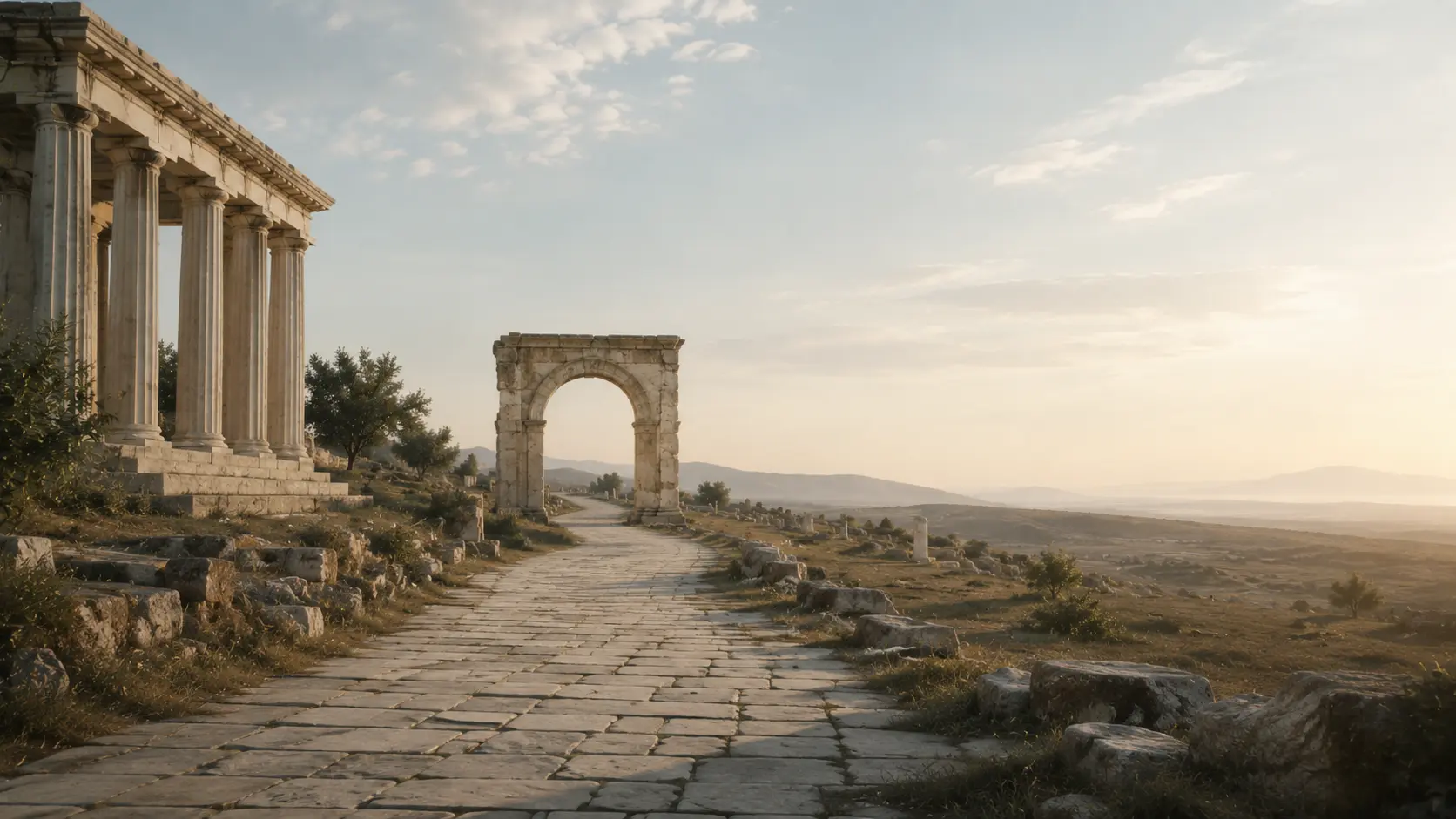
Stoicism History began in Athens around 300 BCE. Zeno of Citium taught in a public porch called the Stoa Poikile, or Painted Porch. That place gave the school its name. The ideas later moved through the Greek world and became especially influential in Rome. If you know Stoicism mainly through Seneca, Epictetus, or Marcus Aurelius, you know an important part of the story, but not the start of it.
The early Stoics also built a wide system about clear thought, nature, and how to live well. In this history of Stoicism, we will follow that system from Greece to Rome, then through its decline, later revivals, and modern practice. Along the way, I will point out what we know, what is uncertain, and what changed.
Here is the main path. The dates are useful guides, not hard borders. Ancient sources are incomplete, so some dates remain approximate.
- Around 300 BCE: Zeno begins teaching in the Stoa Poikile in Athens.
- Around 262 BCE: Cleanthes becomes the second head of the school and keeps Zeno’s work alive.
- Around 230 BCE: Chrysippus takes charge and gives Stoicism much of its detailed shape.
- 155 BCE: An Athenian group of philosophers visits Rome, drawing public attention to Greek philosophy.
- Second and first centuries BCE: Panaetius and Posidonius help Stoic thought reach Roman readers and public life.
- First and second centuries CE: Seneca, Musonius Rufus, Epictetus, and Marcus Aurelius produce the Roman-era work we know best.
- Late 1500s: Justus Lipsius helps form Neostoicism by joining selected Stoic ethics with Christian belief.
- Twentieth century to today: New translations, scholarship, therapy links, books, online groups, Stoic Week, and Stoicon widen the audience.
Where and When Did Stoicism Begin?
The origins of Stoicism are in Athens during the Hellenistic age, the period after Alexander the Great. Athens was still a major place to study philosophy. Several schools taught there at the same time, and they often argued with one another.
Zeno of Citium and the Stoa Poikile
Zeno came from Citium, a city on Cyprus. He reached Athens and studied with several teachers before forming his own school around 300 BCE. He taught at the Stoa Poikile, a public porch painted with scenes from myth and history. People soon called his followers the people of the Stoa, which is where the word Stoic comes from.
You may have heard that Zeno turned to philosophy after a shipwreck. It is a good story, but we should be careful with it. The account comes from Diogenes Laertius, who wrote centuries later. It may preserve an older tradition, yet it is not firm proof of how Zeno’s life changed.
The Ideas That Shaped the First Stoics
Zeno did not begin with an empty page. Socrates helped shape the Stoic belief that character matters more than wealth or status. The Cynic teacher Crates showed him a plain and demanding way of life. Plato’s Academy added questions about knowledge and nature. The Megarian school added careful argument and logic.
So was Stoicism only a mix of older ideas? No. Zeno and his followers joined them in a new way. They argued that a good life needs sound judgment, an understanding of the world, and good action. Those parts were meant to support one another.
Early Stoicism: How the School Built Its System
The Early Stoa usually means the first leaders: Zeno, Cleanthes, and Chrysippus. Almost all their books are lost. We know their ideas through small pieces, later summaries, and critics. That makes the early period harder to describe, but it was the stage when Stoicism became a full school rather than a set of short life tips.
Cleanthes Preserves the School
Cleanthes of Assos followed Zeno as head of the school around 262 BCE. Later stories picture him as poor, hardworking, and deeply loyal to his teacher. His main historical role was simple but important: he kept the young school going. Most of his writing is gone, but his Hymn to Zeus survives. It shows a world ordered by reason and a human duty to live in line with that order.
Chrysippus Systematizes Stoicism
Chrysippus of Soli became the third head around 230 BCE. Ancient reports credit him with many works, though only pieces remain. He gave detailed answers to rival schools and worked across nearly every part of Stoicism. His work in logic was especially important. He studied how statements connect, how arguments work, and when a conclusion follows from what came before it.
Why does he matter so much? Zeno founded the school, but Chrysippus built much of its working frame. A later saying claimed that without Chrysippus there would have been no Stoa. The line is praise, not a measured fact, but it shows his standing in the ancient world.
Logic, Physics, and Ethics Belonged Together
Ancient Stoicism had three linked parts. Logic trained people to test claims and judge what they knew. Physics asked how nature and the whole world worked, including where humans fit within it. Ethics asked how a person should live. You could not simply remove one part without changing the others. The goal was good character, but clear thought and a view of nature were meant to guide it. This is why Stoicism began as much more than a list of moral quotes.
Middle Stoicism: How the Philosophy Moved Toward Rome
After Chrysippus, the center of the story slowly moved beyond the Athenian school. Historians often call the second and first centuries BCE the Middle Stoa or Middle Stoicism. That label is useful, but scholars debate where the period begins, where it ends, and whether these thinkers formed one clear stage.
The Embassy to Rome and a New Audience
A simple turning point came in 155 BCE. Athens sent three philosophers to Rome on a public mission. Diogenes of Babylon represented the Stoics. Carneades represented the Academy, and Critolaus represented Aristotle’s school. Their public talks drew attention. The visit did not make Rome Stoic overnight, but it gave many Romans a close look at Greek debate.
Panaetius and Posidonius Adapt the Tradition
Panaetius later developed close ties with leading Romans. His work on duties influenced Cicero’s On Duties, although Cicero himself was not a Stoic. Panaetius seems to have placed more weight on daily roles and public duty, and he did not accept every early Stoic view.
His student Posidonius taught on Rhodes and wrote on many fields, from ethics to the natural world and history. Both men brought Stoicism into wider talks with Roman life and other schools. Did they replace early Stoicism? No. They kept much of it while changing some points and choosing new areas of focus.
Roman Stoicism: The Thinkers We Can Still Read
Roman Stoicism often feels like the whole tradition because its books are the ones we can still read in full. No complete book by Zeno, Cleanthes, or Chrysippus survives. By contrast, we have major works from Seneca, Epictetus, and Marcus Aurelius. These writers often focus on ethics and daily practice. That focus is real, but it can hide how wide the earlier Stoic system was.
Seneca: Stoicism in Public and Private Life
Seneca lived in the first century CE. He wrote essays and letters about anger, grief, time, wealth, friendship, and death. He also served as an adviser to Emperor Nero and became very wealthy. That gap between his teaching and his life has long raised questions. It also makes him useful to read with care. Seneca did not write from a quiet life outside society. He tried, sometimes unevenly, to apply Stoic ideas inside power, risk, and moral compromise.
Musonius Rufus: Philosophy as Daily Training
Musonius Rufus was a Roman teacher and the teacher of Epictetus. His lessons survive through reports made by others. He treated philosophy as daily training, not as clever talk. He discussed food, clothing, hardship, family life, and education. He also argued that women and men share the same ability to develop good character and should both study philosophy.
Epictetus: Choice, Judgment, and Freedom
Epictetus was born into slavery in the first century CE and was later freed. After philosophers were forced out of Rome under Emperor Domitian, he taught in Nicopolis in Greece. Epictetus wrote no books that we know of. His student Arrian recorded the Discourses and made the shorter Handbook.
His central question was practical: what is truly up to you? Your choices, aims, and judgments are yours to work on. Many results are not. This is often called the dichotomy of control. It does not mean you control every first feeling. It means you can examine the belief you accept and choose your next action.
Marcus Aurelius: A Ruler’s Private Practice
Marcus Aurelius ruled the Roman Empire from 161 to 180 CE. During war, illness, and political pressure, he wrote notes to remind himself how to act. We now call these notes Meditations, but he did not give them that title or prepare them for readers. They are not a full Stoic textbook. They are one person’s private practice, shaped by teachers such as Epictetus. That is why the book can feel direct and moving, but also repeated and unfinished.
Stoicism After the Roman Era
Decline as a Formal School and Later Transmission
There was no single day when Stoicism ended. Its schools, teachers, and public role weakened in late antiquity as the Roman world changed and new schools and religions grew. Many early works were no longer copied, so they disappeared. Still, the ideas did not vanish.
Later Platonist and Christian writers read, used, or argued against Stoic thought. Seneca’s letters and versions of Epictetus continued to circulate. Christian readers often valued Stoic work on discipline and character, while rejecting parts of its view of God and the physical world. What survived was therefore selected and reshaped.
Renaissance Neostoicism
In the late 1500s, the scholar Justus Lipsius led a clearer revival. His 1584 book On Constancy asked how people could use Stoic steadiness during war and public disorder. This movement is now called Neostoicism.
Was it simply ancient Stoicism reborn? Not quite. Lipsius joined selected Stoic ethics with Christian belief. He kept ideas about character and endurance but changed or rejected parts of ancient Stoic physics. Neostoicism shows that a tradition can return by being adapted, not copied whole.
The Modern Revival
The modern revival did not begin with one book or one person. Better editions, translations, and academic study made ancient texts easier to reach during the twentieth century. Scholars also rebuilt early Stoic ideas from later reports and surviving pieces. This helped readers see beyond Marcus Aurelius and recover Stoicism as a broad system.
Modern psychology created another path of interest. In 1955, psychologist Albert Ellis developed rational emotive behavior therapy, or REBT, a form of talk therapy. He openly drew on the Stoic idea that our beliefs about events shape much of our distress. Later therapies that work with patterns of thought use some similar steps, such as checking a belief before accepting it. But the boundary matters: modern therapy has its own evidence, clinical methods, and standards. It is not simply ancient Stoicism with a new name. Stoicism is a philosophy, and it should not replace mental-health care when care is needed.
A public, organized revival became easy to see in 2012. After a workshop at the University of Exeter, Stoicism Today began in October. The first Stoic Week followed in November. Since then, books, podcasts, online groups, courses, Stoicon events, and local meetings have brought Stoic practice to people outside universities.
So what does modern Stoicism mean? There is no single fixed version. Some people focus on journaling and the question of control. Others study ancient texts, social duty, logic, or the Stoic view of nature. Most modern readers do not accept every ancient claim about the physical world. Many select practical exercises and ethics instead.
That choice can help, but it can also narrow the picture. Stoicism is not emotional silence, and a few Marcus Aurelius quotes do not stand for the whole school. Ancient Stoics allowed that a first feeling can arise before you choose it. Their concern was what judgment you accept and what you do next. Their goal also included care for other people and responsible action, not withdrawal from life.
How Did Stoicism Change Over Time?
If I had to sum up the change, I would put it this way: the setting, surviving books, and common focus moved, while the concern with reason, character, and living well stayed near the center.
| Period | Main setting | Common focus | Easy mistake to make |
|---|---|---|---|
| Early Greek school | Athens | A linked system of logic, nature, and ethics | Reducing it to short life advice |
| Roman period | Homes, schools, and public life | Ethics, training, duty, and judgment | Treating Roman texts as the entire school |
| Modern revival | Books, therapy links, courses, and online groups | Practical exercises and personal conduct | Assuming all modern Stoics agree |
The table also explains why modern views can feel incomplete. We usually read what survived, and what survived came mainly from Rome. A fair history keeps the practical Roman voice while remembering the larger Greek system behind it.
Frequently Asked Questions About Stoicism History
Who founded Stoicism?
Zeno of Citium founded Stoicism in Athens around 300 BCE. He learned from the Cynic school, Plato’s Academy, and the Megarian school before forming his own school. Cleanthes kept it going after him, and Chrysippus later built much of its detailed system.
When and where did Stoicism begin?
Stoicism began in Athens around 300 BCE, during the Hellenistic age. Zeno taught at the Stoa Poikile, or Painted Porch, in the city’s public market area. The school took its name from that place.
What are the three periods of Stoicism?
The usual three periods are the Early Stoa, Middle Stoa, and Roman or Late Stoa. These labels help organize the story, but their borders are not exact. Scholars also debate how useful the Middle Stoa label is.
Did Marcus Aurelius create Stoicism?
No. Marcus Aurelius lived about four centuries after Zeno founded the school. He was a Roman emperor who practiced Stoicism and wrote private notes now called Meditations. His book is important, but it is not the start or the whole of Stoicism.
Why did Stoicism become popular again?
Stoicism returned through new translations, modern scholarship, links with cognitive therapies, and popular books and online groups. Public projects such as Stoic Week, which began in 2012, also made its exercises easy for beginners to try. The revival has no single leader or fixed form.
From the Painted Porch to the Present
The history of Stoicism follows three broad steps. Zeno founded a Greek school in Athens. Later thinkers built its system and carried it into Roman life, where the fullest surviving books were written. After the formal school faded, readers kept selecting, debating, and reshaping its ideas until modern Stoicism appeared. If you want to continue, begin with a short overview, then read Epictetus or Marcus Aurelius with this history in mind. Their words become clearer when you can see the long tradition behind them.
Sources and Further Reading
These sources provide fuller historical detail and access to surviving texts.
- Stanford Encyclopedia of Philosophy: Stoicism – scholarly history, sources, and the linked Stoic system.
- Internet Encyclopedia of Philosophy: Stoicism – a readable guide to the Greek and Roman periods and later influence.
- Internet Encyclopedia of Philosophy: Neo-Stoicism – Justus Lipsius and the Renaissance revival.
- Modern Stoicism – the history of Stoicism Today, Stoic Week, and Stoicon.
- MIT Classics: Epictetus, Handbook – a public version of Epictetus’ short guide.
- MIT Classics: Marcus Aurelius, Meditations – a public version of Marcus Aurelius’ notes.
- Albert Ellis Institute: About Us – background on REBT and its stated Stoic roots.
Leave a Reply