

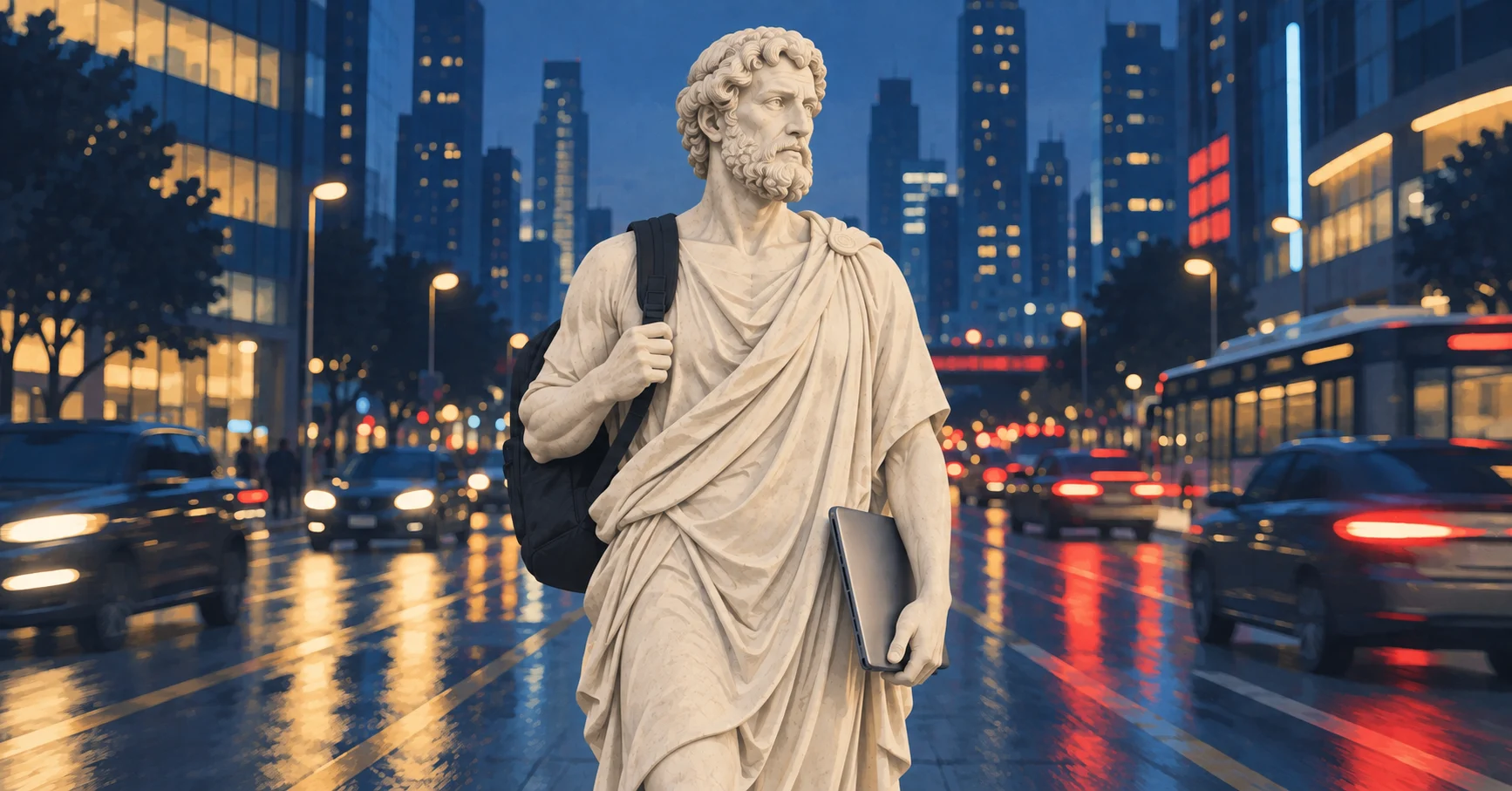
Before I have finished breakfast, I can read about rising prices, a war across the world, and someone my age buying a house I could not afford. I can close the app, but the questions stay with me: Am I doing enough? What happens if my plans fall apart? How much of any of this can I change?
That helps explain why an ancient philosophy has found a modern audience. Stoicism offers a way to live when the future feels uncertain. It asks us to pay attention to our choices, treat other people well, and stop measuring our worth by outcomes we cannot fully control.
The interest is real, although it is hard to put a single number on it. At least 3,650 people signed up for Stoic Week in 2025, a free introduction to Stoic practice. That is one sign of public interest, not a count of everyone who practices Stoicism or proof of why they started. To understand the appeal, I think we need to look at the life into which this philosophy has returned.
Life under pressure, on and off the screen
Money is part of the story. When rent, food, or work feels uncertain, planning for the future can become tiring. In a 2025 survey across 30 countries, 68% of respondents expected inflation to rise in their country over the following year, and 58% expected unemployment to rise. Those worries do not prove that people turn to Stoicism because of the economy. They show the kind of uncertainty in which advice about coping can feel especially useful.
Then there is the pressure to keep improving. We are asked to build careers, stay healthy, be good partners or parents, and make wise decisions about money. Many of these goals are worthwhile. But it is easy to feel that a good life is always one achievement away, or that falling behind means we have failed as people.
Social media sharpens that feeling. A feed can put a friend’s promotion beside a stranger’s perfect home and an alarming headline. I know that I am seeing selected moments, yet comparison can still feel immediate. The same screen brings news of problems far beyond my reach. I can learn about them in seconds without knowing what useful action to take.
But I would miss half the story if I blamed the screen for everything. Social media also helps people find others who are trying to live more thoughtfully. Someone can discover Marcus Aurelius through a short video, ask what a passage means, and hear from people who have tried to apply it. In a study of an online Stoicism community, researchers found that most of the discussions they analyzed involved advice and support about life, rather than academic debate alone. The quality of that advice varies, but the exchange itself matters: philosophy becomes easier to approach when another person is willing to talk it through.
Why look so far back for help?
When life feels noisy, I can see the appeal of advice that begins with a more basic question: What is a good life? Ancient philosophies ask that question before they tell us how to manage our day. They address fear, disappointment, desire, friendship, and duty—experiences that did not begin with smartphones or modern economies.
Their age does not make every ancient claim true. We do not have to accept an entire way of seeing the world to learn from it. What we can do is read it carefully, test an idea in ordinary life, and notice where it helps or falls short. That seems a more useful way to return to the past than treating it as a collection of perfect answers.
Why Stoicism speaks to this moment
Stoicism gives a clear place to start: distinguish your own choices from the results you hope for. I can prepare for a job interview, answer honestly, and decide how I treat the interviewer. I cannot decide whom the company hires. This distinction does not guarantee a calm feeling or a good result. It helps me put my effort somewhere it can count.
The Stoics also challenged the idea that status is the measure of a person. A promotion, praise, or a higher income may be welcome, but none of them tells me whether I have acted wisely, fairly, or courageously. That can be a relief in a culture where comparison is always available. Good character, shown through our actions, is central to Stoic philosophy.
And Stoicism is something people can practice. They can pause before reacting, examine the story they are telling themselves about a setback, or reflect at night on what they did well and what they would change. Stoic ideas helped inspire early forms of cognitive behavioral therapy, a form of talking therapy that helps people examine how their thoughts shape their feelings and actions. That helps explain why parts of Stoicism sound familiar today.
I should be careful with one common misunderstanding. Being Stoic does not mean that I never feel fear, grief, or anger. It means trying to understand those feelings and choose what to do with them. If a colleague is treated unfairly, I may feel angry. I can take that anger seriously without letting it decide every word I say next. Nor does accepting that I cannot control the outcome mean doing nothing: I can speak up and offer help.
Stoicism is one answer among several
The renewed interest in Stoicism sits beside other ways people try to make life more manageable. Mindfulness offers practice in noticing what is happening right now. Minimalism asks which possessions or purchases actually add value. Slow living asks whether every part of life needs to move at the fastest possible pace. Epicurean philosophy, another ancient school of thought, places more weight on simple pleasures, friendship, and freedom from unnecessary distress. Community groups and mutual aid, where people share resources and practical help, ask what we can face together, rather than alone.
These are different approaches, and people often combine them. I might use a Stoic question when a plan fails, put my phone away to give someone my full attention, and rely on neighbors when a problem is too large for one household.
What is worth keeping from the revival?
There is a risk in turning Stoicism into a slogan: be tougher, work harder, accept whatever happens. That may make it easy to sell, but it leaves out much of what drew me to the question in the first place. Some pressures come from unfair workplaces, financial strain, or a lack of support. A calmer reaction can help someone face those conditions; it cannot fix them by itself.
I think Stoicism remains useful when it makes room for both steadiness and action. I can accept that I cannot control every outcome while still caring about justice, asking for help, and changing what I can. Perhaps that is the deeper reason people keep returning to old philosophies. They offer more than a way to get through a difficult day. They ask what kind of life we want to build, and what we owe one another as we build it.
Leave a Reply