

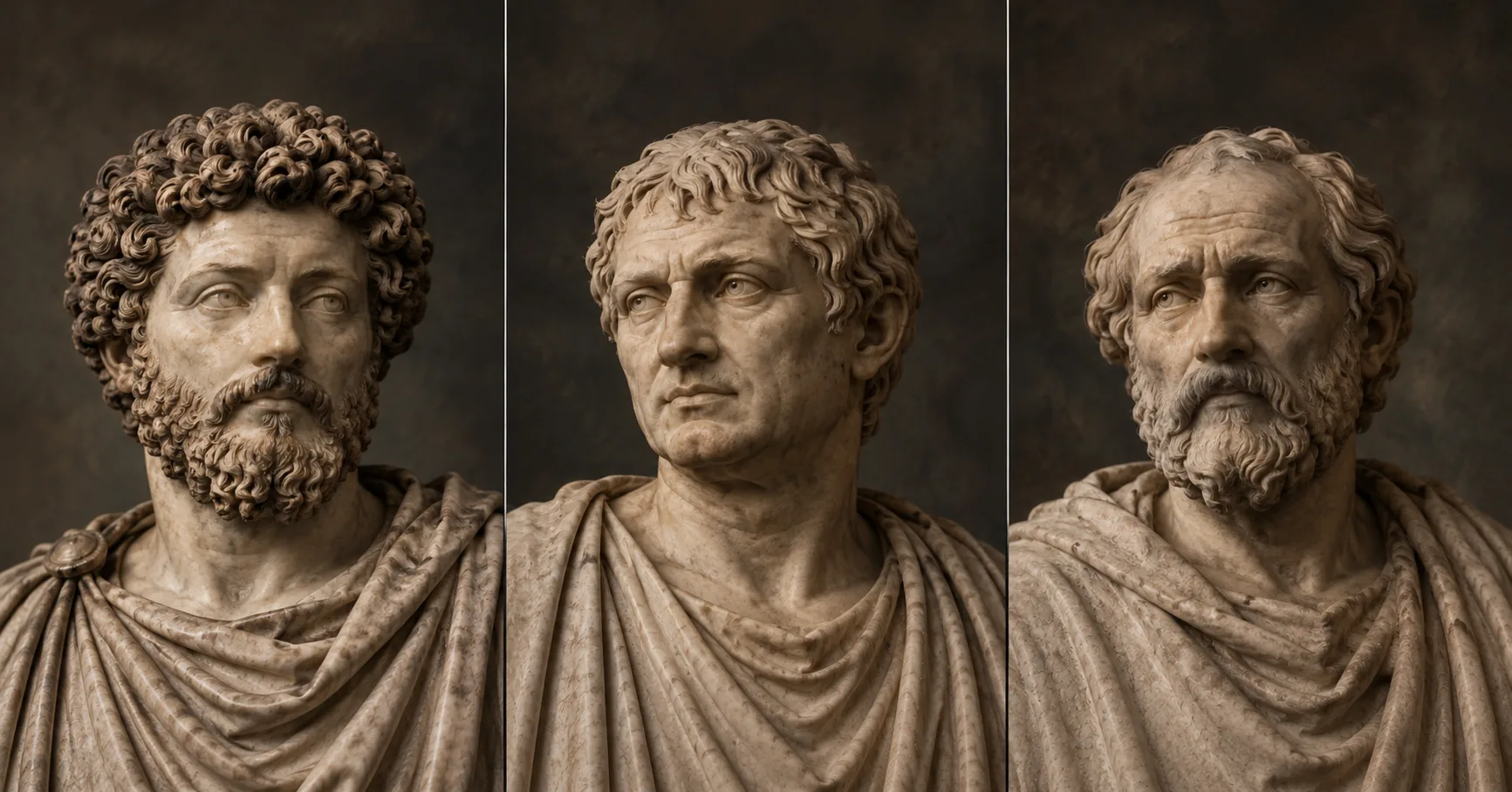
For someone beginning Stoicism, the stoicism philosophers I would suggest first are Marcus Aurelius, Seneca, and Epictetus. Their surviving writings explore how we judge situations, treat other people, and respond to difficulties. Modern thinkers such as Massimo Pigliucci, William B. Irvine, and Lawrence Becker help us consider those ideas in our own time.
If we were talking about this over coffee, I’d probably ask what brought you to Stoicism. Perhaps you want to worry less. Perhaps you’re trying to be more patient. Or perhaps one passage caught your attention, and you want to meet the person behind it.
That’s where I’d begin: with the people and their books. We can learn the unfamiliar terms as we go.
Ancient Stoicism philosophers
These three lived during the Roman Empire. They inherited a philosophy that began centuries earlier in Athens. Much of what we can read about everyday Stoic practice comes through their work.
Marcus Aurelius (121–180 CE)
Marcus became Roman emperor in 161 CE. He had wars, illness, and the responsibilities of government to contend with. He also had a habit many of us might recognize: writing reminders to himself about how to behave.
Those notes became Meditations. They were generally written for his own improvement. His contribution was to leave a detailed record of someone trying to live by Stoic principles.[^marcus]
What I find approachable is the repetition. He keeps returning to patience, duty, and the shortness of life. Clearly, knowing something once wasn’t enough.
In Meditations 5.1, he reasons with himself about getting out of bed. The blankets are pleasant, but there is human work to do.[^morning]
I smile at that passage. Someone could govern an empire and still need a morning pep talk.
Read: Meditations. Take a few passages at a time. An edition with an introduction and notes will help explain unfamiliar references.
Seneca (c. 4 BCE–65 CE)
Seneca was a Roman statesman, playwright, and adviser to Emperor Nero. He was also wealthy. That makes his writing about simplicity and character interesting to read alongside his life.
He developed Stoic ideas through letters and essays about ordinary concerns. Friendship, anger, grief, and wasted time all appear. His writing gives us room to think about the gap between what we believe and what we actually do.[^seneca]
There is humor, too. In Moral Letters to Lucilius, Letter 56, he describes trying to concentrate above a noisy bathhouse. There are grunting exercisers, shouting vendors, and people yelling while having their body hair plucked.
After discussing the importance of inner calm, he admits he plans to move.[^letter56]
That seems a reasonable decision to me.
Read: Letters from a Stoic, usually a selection from his Moral Letters. On the Shortness of Life and On Anger are useful shorter works.
Epictetus (c. 50–135 CE)
Epictetus was born enslaved. After gaining his freedom, he taught philosophy in Rome and later established a school in Nicopolis, Greece.
His teaching centers on our capacity to examine judgments and choose how to act. This became one of Stoicism’s most influential approaches to moral freedom.[^epictetus]
In Enchiridion, section 1, he distinguishes what is up to us from what is not. Our judgments and actions belong in the first group. Reputation and possessions depend on much more than our wishes.[^handbook]
Suppose a friend misunderstands you. You can explain, listen, and admit a mistake. You cannot guarantee the response. I find this distinction helpful when I’m deciding where to put my effort.
Read: Discourses and the shorter Enchiridion, also called the Handbook. His student Arrian recorded and compiled these teachings. Epictetus did not leave us books written directly in his own hand.
Modern Stoic philosophers
Ancient books sometimes need context. Modern writers can help us work through them and ask which ideas still make sense. They also disagree, which gives us something to think about.
Massimo Pigliucci (born 1964)
Pigliucci is an Italian-American philosopher and biologist. His background matters because he takes modern science seriously while exploring an ancient philosophy.[^pigliucci]
His contribution is to examine how Stoicism can guide contemporary life. He keeps returning to character and our responsibilities toward other people. In plain language, that means asking whether our choices are wise, fair, courageous, and restrained.
I would suggest him if you want someone to explain the ideas while working through everyday examples.
Read: How to Be a Stoic (2017). For structured practice, there is A Handbook for New Stoics (2019), written with Gregory Lopez. A Field Guide to a Happy Life (2020) revisits Epictetus for modern readers.
William B. Irvine (born 1952)
Irvine is an American philosopher who taught at Wright State University until retiring in 2021. His writing has helped introduce Stoic practice to readers outside philosophy departments.[^irvine]
He gives particular attention to tranquility, appreciation, and setbacks. One exercise he discusses is briefly imagining the loss of something we value. The purpose is to notice what we already have and may be taking for granted.
That might mean recognizing the value of an ordinary conversation with someone we love. There is often more in an uneventful day than we notice.
Read: A Guide to the Good Life (2008). The Stoic Challenge (2019) focuses more closely on meeting difficulties. Both offer modern interpretations, which are worth comparing with the ancient texts.
Lawrence C. Becker (1939–2018)
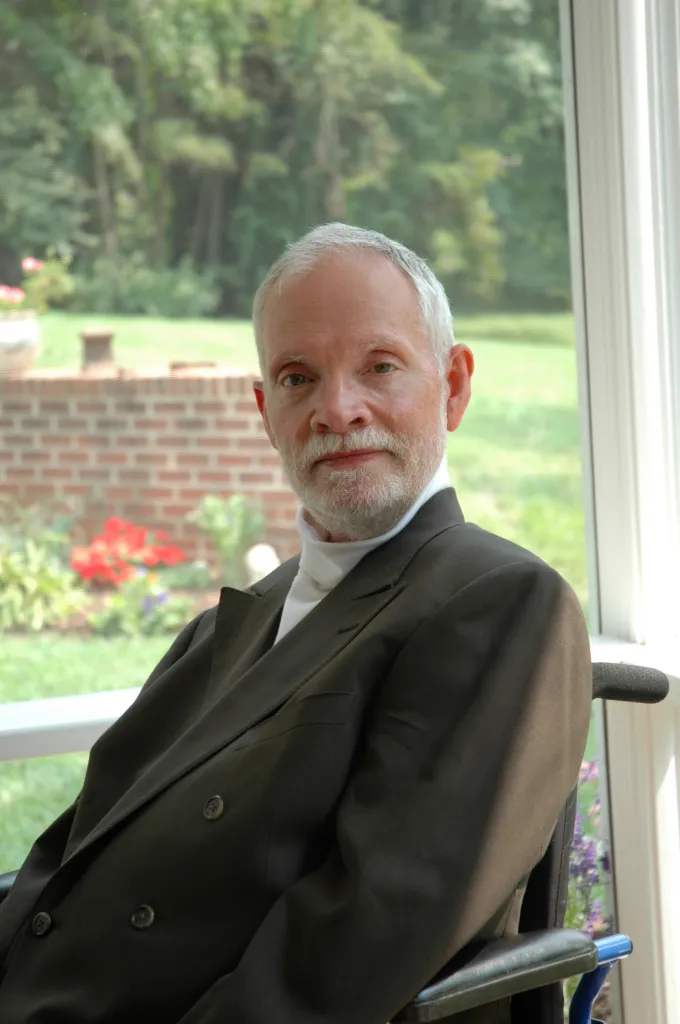
Becker was an American philosopher who worked on ethics and political philosophy. He took on a large question: what might Stoicism look like if it had continued developing alongside modern science?
His answer was a reconstruction of Stoic ethics. It emphasizes reason, good character, and thoughtful action without requiring belief in the ancient Stoics’ divinely ordered universe.[^becker]
I would leave his book until you feel curious about the reasoning behind the practical advice. It asks for more concentration than the other modern introductions here.
Read: A New Stoicism (1998; revised 2017).
Their connections
These Famous Stoicism philosophers belong to a long conversation. Some knew one another. Others met through books.
Musonius Rufus taught Epictetus. Arrian preserved Epictetus’s teaching. Marcus later encountered those teachings through texts. In Meditations 1.7, he thanks his mentor Rusticus for introducing him to Epictetus’s discourses. Marcus was not a documented personal student of Epictetus.[^epictetus][^rusticus]
Seneca and Epictetus influenced Justus Lipsius, who adapted Stoicism to Christianity during the Renaissance. Much later, Pierre Hadot studied Marcus in relation to Epictetus, helping explain the exercises behind Meditations.[^lipsius][^hadot]
Among the modern writers, Becker influenced Pigliucci’s work on updating Stoicism. Pigliucci also disagrees with Irvine’s proposed category of “partial control.” He argues that such situations can be separated into elements that are up to us and elements that are not.[^debate]
You don’t need to settle that debate before beginning. It is a useful reminder to read thoughtfully and leave room for questions.
A few more names
I’d also introduce you to these three. Each adds something that can be easy to miss if we only read the familiar names.
Musonius Rufus (c. 30–before 102 CE)
Musonius was a Roman teacher whose contribution extends beyond teaching Epictetus. He applied philosophy to food, work, marriage, and education. He also argued that women should study philosophy alongside men.[^musonius]
His Lectures and Fragments, preserved by others, show how closely philosophical practice can touch ordinary habits. He deserves attention for those ideas in his own right.
Justus Lipsius (1547–1606)
Lipsius was a Flemish scholar living through religious conflict. His On Constancy (1584) explored how people might remain steady amid public upheaval.
He became a major figure in Neostoicism, a revival that adapted Stoic ideas to Christianity.[^lipsius] His place in the story helps us see how much happened between ancient Rome and today’s bookshelves.
Pierre Hadot (1922–2010)
Hadot was a French philosopher and historian of ancient thought. He explained how philosophy could be a way of life, practiced through habits of attention and reflection.
His The Inner Citadel helps us read Marcus’s repeated reminders as deliberate exercises. Philosophy as a Way of Life explores this approach more broadly.[^hadot] I would give him a place here as an interpreter who helps us understand what the ancient writers were doing.
There are earlier figures we should remember, too. Zeno founded Stoicism around 300 BCE. Chrysippus developed much of its theory. Neither left a book that survives complete. That is why this beginner’s reading list gives them less space.
Panaetius shaped discussions of duty. Posidonius connected philosophy with scientific inquiry. Their works also survive through fragments and later accounts. Cleanthes, Zeno’s successor, left the surviving Hymn to Zeus, although most of his writing is lost.[^founders]
Their absence from the main list reflects the surviving material, not their importance.
Where I’d start
If you asked me to choose one book for you, I’d suggest Seneca’s selected letters for their familiar concerns. If personal reflection appeals more, choose Marcus’s Meditations. If you want a modern explanation first, try Pigliucci’s How to Be a Stoic.
Then read slowly. Find one passage that touches something happening in your life. Try it during the day. Later, ask what helped and what you still don’t understand.
I’m still learning to bring that patience to the practice. We have time to meet the other writers. One book is enough to begin.
A few questions
Who founded Stoicism?
Zeno of Citium founded Stoicism in Athens around 300 BCE. Later leaders, especially Chrysippus, developed the school’s ideas further.
Which philosopher should I read first?
Seneca is a friendly starting point if you like letters about everyday concerns. Marcus Aurelius suits reflective reading, while Epictetus offers more direct instruction.
Did Epictetus write the Handbook?
The Handbook presents Epictetus’s teachings. His student Arrian compiled it from the material associated with the Discourses.
Can I begin with modern Stoicism?
Yes. Pigliucci and Irvine offer accessible introductions, and reading ancient sources alongside them can help you recognize where interpretation and adaptation enter the picture.
[^seneca]: Internet Encyclopedia of Philosophy: Seneca.
[^letter56]: Seneca, Moral Letters to Lucilius, Letter 56.
[^epictetus]: Stanford Encyclopedia of Philosophy: Epictetus.
[^handbook]: Epictetus, Enchiridion, section 1.
[^marcus]: Stanford Encyclopedia of Philosophy: Marcus Aurelius.
[^morning]: Marcus Aurelius, Meditations, Book 5, section 1.
[^becker]: Hollins University: A New Stoicism; William & Mary: Lawrence Becker.
[^pigliucci]: Massimo Pigliucci: Books; Festivaletteratura: Massimo Pigliucci.
[^irvine]: William B. Irvine: Biography; University of North Texas: Author record; Oxford University Press: A Guide to the Good Life; publisher listing: The Stoic Challenge.
[^rusticus]: Marcus Aurelius, Meditations, Book 1, section 7.
[^lipsius]: Stanford Encyclopedia of Philosophy: Justus Lipsius.
[^hadot]: Pierre Hadot, The Inner Citadel; Wiley: Philosophy as a Way of Life.
[^debate]: Massimo Pigliucci: Updating Epictetus and Stoicism for the 21st Century.
[^musonius]: Internet Encyclopedia of Philosophy: Musonius Rufus.
[^founders]: Stanford Encyclopedia of Philosophy: Stoicism; Oxford: Panaetius of Rhodes; University of St Andrews: Posidonius; Mohr Siebeck: Cleanthes’ Hymn to Zeus.
[image soure]: https://blog.apaonline.org/2017/04/14/lawrence-becker/
Leave a Reply