

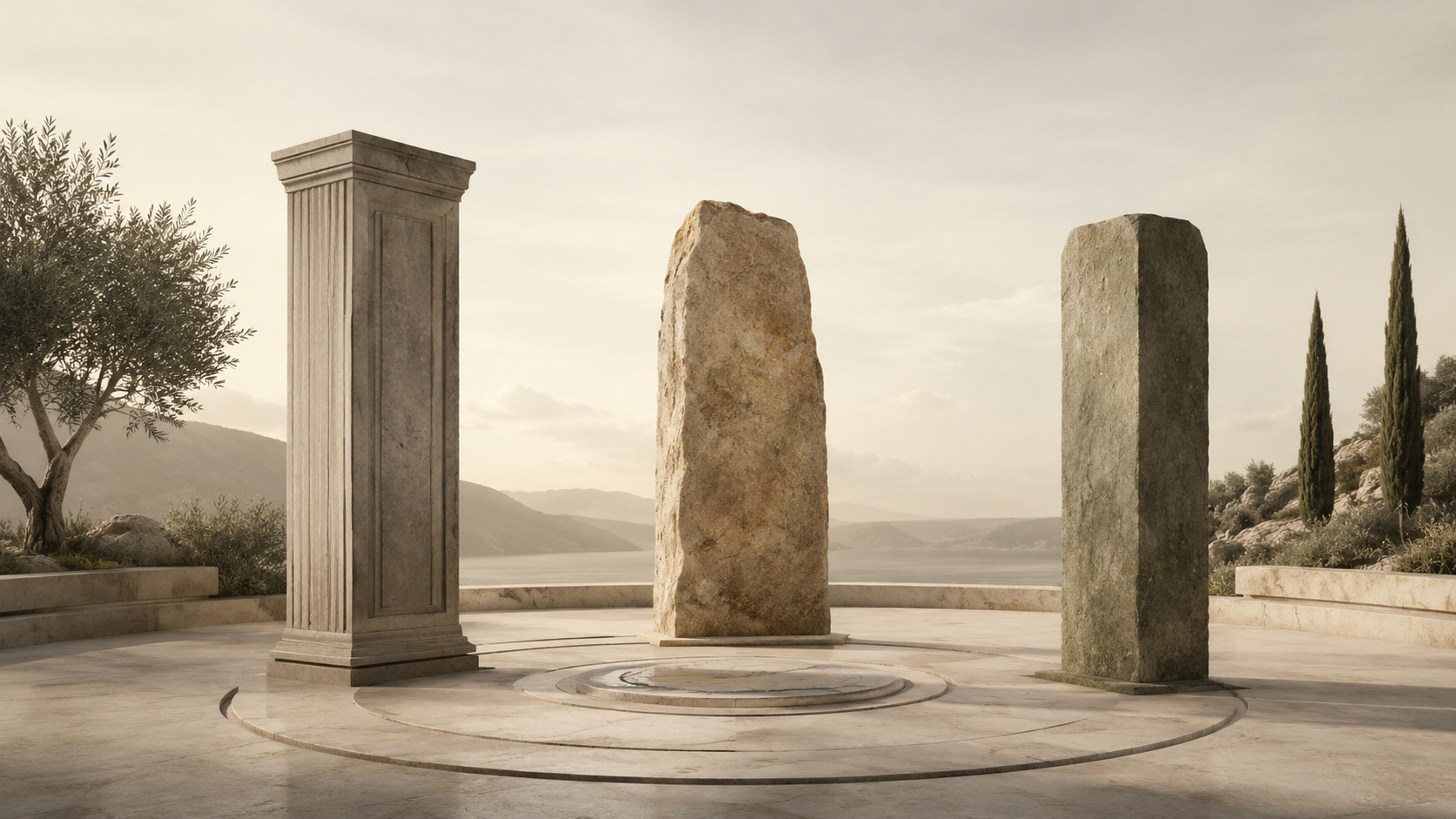
The three most well known stoic philosophers are Marcus Aurelius, Seneca, and Epictetus. They are often called the “Big Three Stoics” because their writings are the easiest entry points into Stoicism today: Marcus shows us Stoicism in leadership, Seneca shows us Stoicism in everyday life, and Epictetus shows us Stoicism as inner freedom.
Who were the stoic philosophers known as the Big Three?

When asked “who were the Stoics?”, we often find about three names: Marcus Aurelius, Seneca, and Epictetus. They were not the only Stoic thinkers, but they are the ones most modern readers meet first.
What I find beautiful about them is that they did not live the same kind of life. Marcus Aurelius was a Roman emperor. Seneca was a wealthy statesman, writer, and advisor. Epictetus was born enslaved and later became a teacher.
That range matters. It reminds me that Stoicism was never just a philosophy for one personality type, one social class, or one perfect lifestyle. It was practiced in palaces, political life, classrooms, and ordinary hardship.
The Big Three Stoics are helpful because each one gives us a different doorway into the same basic question: How can we live with more wisdom, courage, self-control, and peace, no matter what life gives us?
Why is Marcus Aurelius the Stoic philosopher of responsibility?
Marcus Aurelius is probably the most famous Stoic philosopher today, partly because of his book Meditations. What makes Meditations so moving is that it was not written as a polished book for the public. It was more like a private journal, a place where Marcus reminded himself how to live.
That is one reason I return to him often. He does not sound like someone trying to impress us. He sounds like someone trying to stay steady.
Marcus ruled the Roman Empire from 161 to 180 CE. His reign included war, political pressure, and plague. Yet in Meditations, especially in Book 5, he repeatedly returns to the same idea: wake up, do your work as a human being, and meet the day with discipline.
I find this both comforting and confronting. Comforting, because even an emperor struggled to get out of bed and face his responsibilities. Confronting, because Marcus does not give himself many excuses.
His Stoicism is not about escaping duty. It is about meeting duty with a clearer mind.
What can we learn from Marcus Aurelius?
The lesson I take from Marcus Aurelius is this: we do not control the whole world, but we are still responsible for the person we become within it.
In Meditations, Marcus often reminds himself that other people may be difficult, selfish, or confused. His task is not to become bitter because of them. His task is to remain just, patient, and useful.
That is a hard lesson. I still fail at it. But it gives me a practical question to carry into the day:
What kind of person do I want to be in this situation?
Marcus is especially helpful for anyone who feels burdened by responsibility: leaders, parents, managers, creators, or anyone trying to do the right thing under pressure.
Why is Seneca the Stoic philosopher of everyday life?
Seneca feels different from Marcus Aurelius. While Marcus writes like a man speaking quietly to himself, Seneca often writes like a wise older friend sending letters.
His best-known works include Letters from a Stoic, also known as Moral Letters to Lucilius, and essays such as On the Shortness of Life and On Anger. Seneca wrote about time, friendship, wealth, fear, grief, ambition, and the emotional messiness of being human.
That is why I think Seneca is often the easiest Stoic philosopher to read first. He speaks directly to many of the things we still worry about today.
In On the Shortness of Life, Seneca argues that life is not necessarily too short; rather, we lose much of it by spending it carelessly. In the Moral Letters, such as Letter 16, he presents philosophy as something to practice, not merely something to admire from a distance.
I appreciate that because it makes Stoicism feel less like a museum of ancient ideas and more like a daily training ground.
What can we learn from Seneca?
The lesson I take from Seneca is this: pay attention to how you spend your life, because your attention is your life.
Seneca often challenges us to look at our habits. How much time do we give to anxiety? How much to comparison? How much to trying to look successful instead of becoming wise?
He is not always simple to read. Sometimes his life and his teachings seem to sit in tension. He was wealthy and politically powerful, yet he warned about luxury and ambition. But even that tension makes him feel human to me.
Seneca is useful for people who want Stoicism applied to daily concerns: stress, productivity, fear of the future, money, success, and how to live with more intention.
Why is Epictetus the Stoic philosopher of inner freedom?

Epictetus may be the most direct of the Big Three Stoics. He was born enslaved, later gained freedom, and became a teacher. Unlike Marcus and Seneca, Epictetus did not write books himself. His student Arrian recorded his teachings in the Discourses and the shorter Enchiridion, which means “handbook.”
If Marcus helps me think about responsibility, and Seneca helps me think about daily life, Epictetus helps me return to the foundation: what is truly up to me?
In Enchiridion §1, Epictetus begins with the famous Stoic distinction between what is within our control and what is not. He teaches that our judgments, choices, desires, and actions are ours to work on, while things like reputation, other people’s behavior, and external outcomes are not fully ours.
This can sound simple at first. But the more I sit with it, the more radical it becomes.
Much of my stress comes from trying to control things that were never fully mine to control. Epictetus does not tell us to stop caring. He teaches us to care wisely.
What can we learn from Epictetus?
The lesson I take from Epictetus is this: freedom begins when we stop handing our peace of mind to things outside our control.
That does not mean becoming passive. In fact, Epictetus can be quite demanding. He asks us to train our reactions, examine our judgments, and stop blaming the world for every disturbance inside us.
For beginners, Epictetus can feel blunt. But sometimes that bluntness is exactly what we need. He cuts through excuses and brings us back to practice.
Epictetus is especially helpful when life feels unfair, unpredictable, or emotionally overwhelming. He reminds us that even when we cannot choose the event, we can still work on the response.
What is a simple stoic philosophers list for beginners?
A beginner-friendly stoic philosophers list might look like this:
- Marcus Aurelius — best for reflection, responsibility, leadership, and emotional steadiness.
- Seneca — best for daily life, time, fear, ambition, and practical moral advice.
- Epictetus — best for self-control, resilience, and understanding what is within our control.
- Zeno of Citium — the founder of Stoicism, useful once you want historical context.
- Cleanthes — an early Stoic known for continuing Zeno’s school.
- Chrysippus — a major system-builder of Stoicism, though much of his writing is lost.
- Musonius Rufus — a Roman Stoic teacher who influenced Epictetus.
For most modern readers, I would still start with the Big Three Stoics. Their works are available, readable, and deeply practical.
In what order should you read the big three stoics?

If you are completely new, I would suggest this reading order:
1. Start with Seneca for warmth and everyday examples
Seneca is a gentle entry point because his topics are familiar. You can begin with On the Shortness of Life or selected letters from Letters from a Stoic. His writing feels conversational, and many chapters can stand alone.
2. Read Epictetus for the core Stoic framework
After Seneca, I would read Epictetus’ Enchiridion. It is short, direct, and foundational. It gives you the basic Stoic lens: separate what is up to you from what is not, then focus your energy where it belongs.
3. Return to Marcus Aurelius for reflection
Then read Marcus Aurelius’ Meditations. I say “return to” because Marcus becomes richer after you understand some Stoic basics. His notes are personal and fragmented, so they are easier to appreciate when you already understand the philosophy behind them.
Of course, this is only my suggested path. Some people fall in love with Marcus first. Others need Epictetus’ clarity right away. The best order is the one that keeps you reading and practicing.
How were the stoic philosophers different from each other?
The Big Three Stoics share the same basic philosophy, but they have different personalities.
Marcus Aurelius feels quiet, disciplined, and inward. He is the person I read when I need to remember my duties and stop complaining.
Seneca feels expressive, humane, and practical. He is the person I read when I need help thinking about time, ambition, fear, or the noise of daily life.
Epictetus feels sharp, clear, and uncompromising. He is the person I read when I need to stop pretending I control everything.
Together, they give Stoicism a fuller shape. Marcus shows the inner life of a ruler. Seneca shows the struggles of a public intellectual and advisor. Epictetus shows the dignity of a person who found freedom through discipline of the mind.
Why do these stoic philosophers still matter today?
I think these stoic philosophers still matter because they speak to problems that have not disappeared.
We still struggle with anxiety. We still compare ourselves with others. We still waste time and regret it. We still meet difficult people. We still want control over things that are uncertain.
Stoicism does not remove these problems from life. It gives us a calmer way to meet them.
Marcus Aurelius reminds us to act with character. Seneca reminds us not to waste our lives. Epictetus reminds us to protect the freedom of our inner choices.
I am still learning all of this. Some days I remember it. Other days I react first and reflect later. But that is also part of the practice.
Stoicism, at least as I understand it now, is not about becoming emotionless or perfectly calm. It is about becoming a little more honest, a little more steady, and a little less controlled by every passing event.
FAQs
Who were the most famous Stoic philosophers?
The most famous Stoic philosophers are Marcus Aurelius, Seneca, and Epictetus. They are often called the Big Three Stoics because their surviving works are widely read and offer practical guidance for modern life.
Who should I read first: Marcus Aurelius, Seneca, or Epictetus?
For most beginners, Seneca is the easiest starting point because his essays and letters deal with everyday concerns like time, fear, and ambition. After that, Epictetus’ Enchiridion gives a clear foundation, and Marcus Aurelius’ Meditations becomes more meaningful.
What did Marcus Aurelius teach in Meditations?
Marcus Aurelius used Meditations to remind himself to live with discipline, humility, patience, and responsibility. In Book 5, he reflects on rising to meet one’s duties and acting according to nature, even when life feels difficult.
What is Epictetus best known for?
Epictetus is best known for teaching the difference between what is within our control and what is not. In Enchiridion, he explains that our judgments and choices are ours to work on, while external events are not fully under our control.
Was Seneca a real Stoic philosopher?
Yes, Seneca was a Roman Stoic philosopher, statesman, and writer. His life was complicated, and sometimes his wealth and political role seem in tension with his teachings, but his works remain among the most practical introductions to Stoicism.
Closure
The more I read Marcus Aurelius, Seneca, and Epictetus, the more I feel that Stoicism is not something we “finish” learning. It is something we return to, especially when life feels noisy or uncertain.
These three philosophers are a good beginning, but books can take us deeper, slowly and patiently. If you want to continue the journey, I’ve also gathered some thoughtful books about Stoicism that can help make these ancient ideas feel practical in daily life.
Leave a Reply